My newest book and the third in the Human Rights trilogy is entitled "The Human Rights Industry" -- and that is what it has become, an industry, a business, in which human dignity counts less than scoring points against geopolitical rivals, where famine and death are less important than gender ideology. The noble principles of human rights have been weaponized and the spirituality of the Universal Declaration of Human Rights appears lost -- the enthusiasm and humanity of Eleanor Roosevelt, René Cassin, P.C. Chang and Charles Malik. Où sont les neiges d’antan? Even in 1989-91 there was hope in the air, a brief shining moment of optimism for the future of humanity, but Bill Clinton smashed it with his megalomania and dreams of a unipolar world in which the US would dictate "values" to the rest of the world. Indeed, human history repeats itself, is laced with tragedy. The Pax Americana is no better than the Pax Romana ever was.
My 2022 book "Countering Mainstream Narratives" (Clarity Press, Atlanta, Georgia) is a follow-up to my 2021 book "Building a Just World Order" with the 25 Principles of International Order. Already the first reviews are coming out in Englisn and German. https://www.claritypress.com/product/building-a-just-world-order/ See also https://www.claritypress.com/product/countering-mainstream-narratives-fake-news-fake-law-fake-freedomcountering-the-mainstream-narratives-fake-news-fake-law-fake-freedom/
In all three books I make the point that "If we want to make America great again, we should begin by reviving the legacy of Eleanor Roosevelt, especially those virtues that made Americans loved worldwide, and by reaffirming our commitment to the achievement of FDR's Four Freedoms. MAGA does dot mean bullying - it means listening, opening up, cooperating with others, convincing by reason, practicing international solidarity, showing compassion. "
see my essays in Counterpunch https://www.counterpunch.org/author/alfred-de-zayas/
see my book "Building a Just World Order" https://www.claritypress.com/product/building-a-just-world-order/
Many political crises we endure are the result of brain-washing and indoctrination which make us lose a sense of reality and impose a template on our brains, a faulty prism that distorts our perception of persons and events -- we are told whom to like and whom to despise, whom to believe and whom to ignore. We are taught to hate some people who the media brands as our "enemies", enemies of democracy, of capitalism, of human rights -- meaning enemies of Western hegemony. The Roman historian Tacitus (AD 55-117) wrote in Agricola, 42: "proprium humani ingenii est odisse quem laeseris" -- "it is human nature to hate those whom we have hurt". That is exactly what the politicians do, what historians do, what the mainstream meadia does. We are told to hate the victims of our injustice -- thus for centuries we despised and abused slaves and those whom we exploited during imperialistic and colonialistic enterprises. Thus we hate the Palestinians, whom we have deprived of their land and sustenance. We invert the victim and perpetrator roles and accuse the victims of being terrorists. Nihil novum sub sole est! (Ecclesiastes I, 10)
see my essay on credibility of the US and NATO, 10 January 2022, in Zeitgeschehen im Fokus
for my essay of 15 March 2022 on censorship
for my essay of 8 June 2022 on diplomacy in Ukraine
for my essay of 29 September 2022 on peace as a human right
for my essay of 12 October 2022 on the usefulness of referenda
Wikiquote
The San Francisco non-governmental organization ELEANOR LIVES is committed to making that legacy known to everyone on this planet
My Blog
SITE OF THE INDEPENDENT
EXPERT on the promotion of a democratic and equitable international order
UN Special article on my mission to Venezuela
Interview in Le Courrier de Genève on my mission to Venezuela and Ecuador
Youtube
interview on free trade agreements, whistleblowers,
UN reform
Webstory on
the human right to peace on first page of OHCHR website on 4-5
April 2013
The mandate of the independent expert on the promotion of a democratic and equitable international order, which I had the honour to administer from 1 May 2012 to 30 April 2018, entails a generous synthesis of civil,
political, economic, social and cultural rights. The title requires
the expert to be truly independent, keep an open mind, conduct
his/her research objectively and without ideological prejudices,
listen to all sides of an argument and seek the opinion of all
stakeholders, including academics, experts, government officials and civil society, and impervious to instructions or influence from governments, lobbies, non-governmental organizations, the OHCHR or even subtle "peer pressure" from other rapporteurs. Independence is the added value of any mandate -- not just bean-counting or compiling, but trying to understand the problems, identify the causes, the obstacles, the phoney explanations, and pushing back against intimidation and the pressures of self-censorship
and political correctness. The essence of an independent expert
is not merely his/her expertise -- which must be considered
a given -- but the faculty of thinking both inside and outside the box, while rigorously
respecting the terms of reference laid down in the resolution
establishing the mandate, and observing the code of conduct
of rapporteurs. The mandate is not intended to duplicate or rehash
existing knowledge, to go along with mainstream views, to grandstand and condemn, but to offer new impulses, perspectives, emphasis, formulate constructive proposals so as
to advance the Purposes and Principles of the United Nations
-- with intellectual honesty and good faith. The defining characteristic of my six years on the job was: audiatur et altera pars -- listen to all sides. Another characteristic is giving reason priority over passion.
Methodologically a mandate holder should not rely
on templates, but instead listen and remain open to correction,
and avoid being identified with any ideology other than a commitment
to human dignity. While an
independent expert inevitably brings with him a certain cultural
and educational predisposition, he must be able to jump
over his own shadow and get at the facts. Naming
and shaming is seldom a solution to violations of human
rights. Experience shows that naming and shaming is mostly counter-productive. Far more important is uncovering the root causes of the
violations, such as endemic inequalities, the persistence of privilege
and the culture of violence. Important too is the anthropocentric
approach and the commitment to devise measures to
give recognition and reparation to the victims. The mandate holder must also have the
courage to formulate recommendations that entail more than a "band
aid" and
require changes of paradigm and mindset. Most importantly, a mandate
holder should have the courage to break the silence about topics
that are being ignored -- not only by States but by the human rights
industry, which has been increasingly influenced by major donors from big business
and special interests. He should give impulses and concrete recommendations
to governments and civil society, speak clear language, tear
down pretenses and double-standards. One thing he must not
be: a guardian of the status quo, a fig leaf for the international
community, so that everybody pretends to have a good conscience
and continue "business as usual".
Mandate holders may draw some inspiration
from Robert Frost's The
Road not Taken:
Two roads diverged in a yellow wood
and sorry I could not travel both ...
Two roads diverged in a wood, and I --
I took the one less traveled by,
And that has made all the difference
Mandate holders should also remember Horace's Epistles
-- Dimidium facti, qui coepit,
habet: sapere aude, / incipe (I, 2, 40).
Let's get started and then have the courage to use our judgment!
Immanuel Kant also propagated this idea that became key to the
Enlightenment
-- just two words: the imperative sapere
aude!
What is needed is a new functional paradigm for human rights, a mode d'emploi to live in and for human dignity.
https://www.unspecial.org/2017/04/a-new-functional-human-rights-paradigm/
One of the problems with the "human rights industry" is the lack of vision -- the tendency simply to put "band aids" on problems rather than going for the root causes and try to formulate sustainable solutions. Again and again I see the OHCHR, the Human Rights Council, the Special Procedures, Special Rapporteurs, Independent Experts essentially copping out -- instead of addressing the issues clearly and directly, taking a politicized, Zeitgeist-corrupted and politically correct approach to universl problems. This always makes me think of one of Goethe manny clever maxims "Wer das erste Knopfloch verfehlt, kommt mit dem Zuknöpfen nicht zu Rande." -- If you miss the first buttonhole, you will never manage it properly. Ask the wrong questions -- expect to get useless answers.
24 September - speak with the Director-General of ICRC Pierre Krähenbühl -- brilliant mind.
23 September - Claudia Cardinale dies at 87 in Paris, unforgettable in Once Upon a Time in the West and Fitzcarraldo
20 September - boat trip in Lake Thun and swim at Faulensee
19 September - hike up the Gemmi pass
18 September - hike the Simplon to the Hopschuhsee. pick lots of blueberries
17 September - travel to Bern where Carla got her new Dutch passport, then over to Belalp and the Aletschbord.
16 September - Robert Redford passed away. Never forget Butch Cassidy and the Sundance Kid -- the film I saw again and again after each Harvard law school exam.
31 August - spend the day with Martin and Marketa, walk down to the lake -- their dog sissy keeps barking at the waves in the lake -- and at ever other dog
30 August - drive frin St. Quintin to Le Parcey on the shore of La Loue -- cannot swim, because the river is polluted, buy wine in Poligny
29 August -- start driving back to Geneva, get into a horrible traffic jam in Lille, visit the Cathedral of Amiens in France, spend the night in St. Quentin
Dahlias at the Keukenhof castle

Drenthe
De Haar
Duivenvoorde
5 August - cycle to the deer in the forest near DeZilk
4 August -- first swim in the North Sea -- chilly and big waves
3 August -- lunch with Lia Edelenbos in Veldhofen, arrive in Noordwijk under rain and thunder
2. August -- travel to Holland by car, stop in St. Vith, Belgium for the night
1 August -- Stefan would have turned 29 today. Carla and I went to the cemetery and watered the flowers. Can't believe it was so long ago.
31 July -- two webinars and visit by Blerim
30 July meet Alix at La Botiniere, Jardin Anglais
25 July walk two flying bridges (hängebrücken) in Saas Almagell
22 July - wonderful production of Carl Maria von Weber's opera Der Freischutz at the Bregenz Festival.
15 July fly Hong-Kong Geneva with Swiss -- see 2 movies -- Monsieur Aznavour and a very funny Chinese comedy -- Honey, Money, Phony
14 July fly back to Hong Kongva with Cathay airlines -- drink a very good white wine from Xinjiang
13 July visit Penelope Seidler at Killara
12 July - Carmen at Sydney Opera House
5 July -- Carla's 67th birthday -- we fly over Lake Eyre
27 June -- swim with whale sharks at Ningaloo Reef -- also turtles to be admired
21 June -- fly to Perth
17 June -- fly Zurich-Hong Kong - Syndey
15 June -- big storm over Geneva, thunder and hale.
9-12 June hiking in Wallis.
1 June - 100th anniversary of the "maison de paroisse" we had about 50 guests and a successful literary workshop
31 May --- traditional plunge in Geneva lake at the Reposoire -- 17 degrees C
13 May - Jose Mujica, former president of Uruguay, dies aged 89.
12 May - last lecture on international jurisprudence
11 May - one of the two female tortoises, Julia, dies unexpectedly. She was alive yesterday.
21 April -- Pope Francis dies aged 88.
20 April -- Pope Francis gives the Urbi et Orbi blessing.
19 April -- Rijksmuseum - meet Walter Rabus there
17 April Keukenhof
16 Apil - Warmond and Leiden
15 April -- pick up Vicky at Schiphol
14 April -- teach my course and fly to Holland
8 April -- travel to Delemont in the Canton of Jura to admire the 8th century Bible from the Grandville Cloister
7 April -- Martin comes by for dinner
5 April -- PEN General Assembly
3 April -- meet Miriam Estrada at the Serpentine bar. Lunch with Blerim at the cafeteria.
2 April -- concert at St John XXIII -- we sang 7 Taize songs, followed by an oecumenical dinner -- soup and cheese
30 March -- Mussorgsky's Khovanchina at the Grand Theatre.
29 March -- webinar on the adverse human rights impacts of Trump's trade wars and tarifs
24 March -- Carla is reelected for a second 5-year term as conseillère municipale
23 March -- fourth tortoise wakes up -- now our two happy couples are yagain together after four and a half months of hibernation -- Esmeralda and Tobias, Juliette and Romeo. They are not yet hungry. But I did wash them in lukewarm water and gave them to drink. They have not touched their food yet.
21 March -- first day of spring, the third tortoise wakes up. One is still hibernating. UNESCO World Day for Glaciers https://www.unesco.org/en/days/world-glaciers
19-20 March -- skiing in Saas Grund
17 March -- funeral of Anki Flores at St. George cemetery
15 March -- eat the first asparragus of the season -- from Italy
14 March -- consultation with Alena Douhan at the UN H building -- meet with a number of Chinese professors in the Serpentine bar
12 March -- flew back and forth to Brussels -- visited with my Goddaughter Michelle and her dad Kevin, had lunch with Rafael C at "Sabor Latino"
11 March -- Anki Flores passed away at the age of 91. Such a lovely lady with an exquisite taste for Herrend procelain.
the second of the 4 tortoises came out of hibernation -- Tobias. I saw the third -- Romeo, still dug in -- and I guess Juliet prolongs her beauty sleep
10 March -- my dad's 111th birthday ! Remember him fondly -- always.
one of the four tortoises, Esmeralda, just woke up from hibernation. The other 3 are still sleeping.
9 March -- visit Hodler exhibit in Pully
8 March -- Geneva Film Festival of Human Rights -- meet Daniel Premont for the Soros Film on the "Veto" power -- end of the UN ?
28 Feb -- spectacular skiing at Belalp, Aletschbord, Häxe 4
22 Feb -- do the culte based on Matthew 10, 16 -- and the Thomas Gospel
13 Feb -- lunch with South African Ambassador
11 Feb -- travel to the Beyerle museum in Basel to visit the Northern Lights exhibition
10 Feb -- lovely class at GSD
4 Feb - glorious skiing in Saas Grund
3 Feb -- start the new semester at GSD -- the masters seminar on international jurisprudence.
2 Feb -- spectacular performance of Richard Strauss' Salome at the Grand Theatre -- Olesya Golovnova was the Salome, John Duszak was Herod, Tania Baumgartner the Herodias, Gabor Bretz Johanahan, Matthew Newlin the Narraboth. It really shakes you up!
31 Jan -- deliver two lectures at Palma de Mallorca.
30 Jan - my friend and role-model Prof. Dr. Dr. Francis Boyle passes away in Illinois at the young age of 74. He was a genius, an incredibly courageous lawyer and professor.
28 Jan. Jakob Möller is buried in Reykjavik
27 Jan - colonoscopy with Dr. Godin
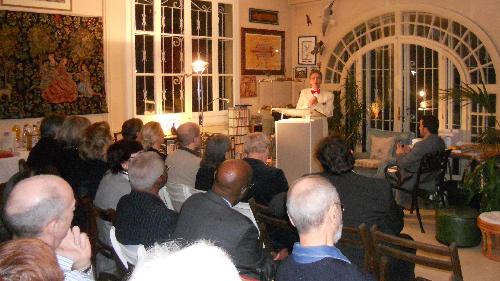
24 Jan -- 30th annual Ex Tempore salon. 36 in the audience, 16 readers in Chinese, English, French, Russiand and Spanish -- alas no Arabic this years - but, the's face it, it is cold and flu season in Geneva.
23 Jan -- give interview on the US elections
18-22 Jan - skiing in Belalp and Saas Grund
14 Jan - Jakob Möller dies in Reykjavik at the age of 88
8 Jan -- hike up to the Rhonequelle Restaurant near Gletsch in Vallis -- some 5 km in beautiful snow. Lovely polenta too.
6 jan - fly back to Geneva
5 jan wake up to snow-covered Noordwijk aan Zee
4 January -- Rijksmuseum van Oudheden - go to Zoetemeer to celebrare Marike's birthday
3 January -- Meesdag museum in The Hague
2 January -- sunny and beautiful -- cycle to Katwijk to the museum, get a tour by a volunteer
1 January - no Nieuwjaarsduik -- windkracht 9 -- spoil my red camera because of sand going into the optic
31 December -- enormous storm -- and fireworks
30 December - recover a lovely oil painting of the tulip fields and willow trees -- discarded in the Duinroos cellar --
29 December -- Jimmy Carter dies -- aged 100. One of the very few US Presidents I admire
28 December van Gogh Museum and dinner with Walter and Wieneke
26 December - fly to Holland
25 December -- beautiful service at Genthod. Watch on the BBC the new Glyndebourn production of Merry Widow with the Australian soprano Danielle de Niesse.
24 December -- lovely Christmas service at Crêts. Sing my heart out.
20-23 December -- skiing at Belalp
19 December -- sing the Christmas concert at the Temple de Petit Saconnex
18 December -- participate in the doctoral commission of Andrea Dias at the University of Geneva
15 December -- sing the Christmas concert at St. Hyppolite
10 December -- 102nd birthday of Edith Ballantyne -- participate in a Zoom conference to sing happy birthday to her -- I spoke about WILPF and my nomination of WILPF for the Nobel Peace Prize.
5 December -- Quick -- 2.2 -- lunch with Sharon Venne at the Ariana -- coffee with the Camp Ashraf survivors at the COOP. Receive a small iranian cloth for Christmas.
3 December - wonderful Exhibit at PN -- meet Sasha Tikhonov -- choir rehearsal
2 December -- lunch with Bruna and Rosita to celebrate Bruna's 85th birthday. Give final exam at GSD.
22 November -- speak at the UN Conference on unilateral coercive measures
21 November -- Martin comes by and we drink a botte of champagne to celebrate my "39th birthday" -- 39 years since my nearla fatal acutomobile accident on the autobahn near Peine
20 November -- Marie Nereser and Eric sing in our salon -- to commemorate the first anniversary of Jean Gaeng's passing away
15 November -- writers in Prison day -- I read a poem by Antonio Guerrero
25-27 October -- lecturing in Vienna
7 November -- we visit Martin and Marketa in Prague
10 September Paul Bailey and Maria Rosa Perrin marry in Versoix
5 September - Martin visits
2 September - first day of classes at GSD
1 September - shower in the garden
29 August - cycle around lakes Rousses & Joux
27 August - swim in La Loue in Le Parcey, buy quenelles in Les Rousses
26 August - leave Noordwijk travel through Yrseke to east oysters and continue to Reims
29 July through entire month of August in Noordwijk, drive through St. Vith
28 June - 5 July Lago Maggiore, Stressa, Sta Catarina del Sasso, Isole di Brissago, Ascona.
24 June -- doctoral commission of Desirée Mortenson
20 - demonstrate with GIPRI and Swiss sans Armee before the Maison de la Paix, where they want to install a liaison office of NATO
17-18-19 horrible cold
11-16 June Hesse Tage Sils Maria, lunch with my editor Dr. Volker Michels and with Prof. Ingo Cornils of Leeds University.
10 June - podcast with Jeff Sachs
2-4 June lecture at Belgrade
17-25 May - Noordwijk aan Zee
29 April - record interview for Vassar college
27 April - P.E.N. General Assembly in Neuchâtel
26 April - Counterpunch article on multilateralism. Victoria Hall -- Russian programme -- Shostakovich 9th
24 April - panel in room XXVII -- full-house. UN Christian Association monthly prayer meeting
22 April -- Immanuel Kant, born in Königsberg 1724 -- 300 years ago. Sapere aude!
21 April - Kevin Madders' 69th birthday. Albane Prophete's 50th birthday.
20 April - PEN meeting at Glorice's. Participate in the colloquium on Palestine at the Université Ouvrière de Geneve.
19 April -- publish essay in Counterpunch on US Vetos in Security Council. Carmen Rueda presents her novel at the Albatros. See Noemy, Maria Francisca, Darka, etc.
15 April -- speak at Club Suisse de la Presse on self-determination for Alaska and Hawaii. 31 march - 11 april. holland
14 april -- concert angel ripoll
31 march - 11 april. holland
28 March -- meet Special Rapporteur Francesca Albanese and speak in two panels on Palestine.
26 March -- publish the first and second Gaza open letters in Counterpunch.
25 March -- speak 11 min. in the Security council briefing on unilateral coercive measures/Arria Formula -- and got the last word, 5 min. ad hoc in which I pointed out that the apology of the crime of UCMs is tantamount to Machiavellism and Orwellianism combined -- a cynical attempt to justify the unjustifiable, to destroy language, to impose cognitive dissonance.
9 March - see Carmen Rosa, Miguel de la Lama, Darka Topali at the book fair in Palexpo.
4 March -- the Sydney law firm Birchgrove submitted a case against PM Albanese in the ICC for complicity in genocide https://birchgrovelegal.com.au/wp-content/uploads/2024/03/ICC-Referral-Australian-Government-Ministers-and-Opposition-Leader-04032024_BLG.pdf
1 March - give interview to CGTN on democracy
29 Feb. two of the tortoises wake up from hybernation -- a boy and a girl -- tobias and esmeralda. Give 2 hour podcast with Meera.
27 Feb -- write an essay for Counterpunch on the implications of Bushnell's sacrifice.
25 Feb-- US airman Aaron Bushnell self-immolates himself in front of the Israeli Embassy in Washington D.C. He live-streamed it -- very, very disturbing. But why die for a cause? Is it not much better to live and continue fighting for justice? God keep his soul. R.I.P.
24 Feb. -- culte by Daniel and then dinner with them in Meyrin
20-23 February - Pontresina, Val Fex, Poschiavo
18 February -- Martin comes by
16 February -- great skiing at Belalp -- a bit mushy toward the end
15 February -- skiing in Saas Grund -- magnificent Gletscher Rot and Hohkraut slopes.
12 February -- good kids in my class, we discuss the ICJ order of 26 January on Gaza.
10 February - a year ago Ivo Petrov passed away. We went to his grave at St. George cemetery and also visited the grave of our little Stefan.
Prof. Yoram Dinstein of Hebrew University passed away aged 88. I met him at a panel in Amsterdam and he reviewed favourably one of my books.
5 February -- start of the semester
3 February -- Organ concert at the Genthod temple. Give long zoom interview to arabic ngo. Do a lovely fire in the salon.
2 February -- founding the a new multilateralism ngo at the Maison des Associations, together with Guy Mettan, Gabriel Galice. Gilles-Emmanuel Jacquet and Prof. Ivo Rens.
31 January -- UN Christian Association
30 January -- Artisan Luis fixes the plafonnier
29 January -- walk on the Charles Bridge, fly back to Geneva
28 January -- Smetana's Opera Dalibor at the Prague Opera House
27 January -- interview with TNT on Gaza. Culte at 6 p.m. Fly to Prague
26 January -- ICJ issues provisional mesures
25 January -- PEN meeting with Alix and Glorice
27 December -- stormy weather, pick up some 20 sea stars from the beach
25 December -- Christmas service at the Oude St Jeroenskerk
24 December -- quiet Christmas dinner in Noordwijk
19 December -- fly to amsterdam
20 December -- funeral at Hellevoetssluis
18 Dec. Carla's sister Johanna dies suddenly. We must fly right away to Holland.
17 Dec. sing the Christmas concert at St. Hyppolyte. Paul and Marie Rose came for dinner. I cooked a wonderful duck.
15 Dec. wonderful Rosenkavalier at the Grand Theatre. We invited Hans Jörg Mathieu and his wife Ursula, whom we call Lea. The Marshallin was the wonderful Swedish soprano Maria Bengtson.
10 Dec. webinar on the 75th anniversary of the UDHR
22 Nov. - 60 years ago JFK was assassinated in Dallas, Texas. His commencement address at American University on 10 June 1963 is as valid today as then -- JFK knew how NOT to provoke Russia, and he would have avoided the Ukraine war -- https://www.jfklibrary.org/archives/other-resources/john-f-kennedy-speeches/american-university-19630610
17 Nov. interview on Gaza
16 Nov. lecture on migration at Uni Mail with Prof. Levrat and Julie Franck
14 Nov. panel on Cuba, room XX - distribute newSpecial
10. Nov. funeral of Jean Gaeng. Dinner with Paul Bailey.
9 Nov. discuss book on PEN Suisse romand with Alix.
8 Nov. consultation with Alena Douhan
4 Nov. Jean Gaeng dies at his home in Champel -- 98 years old. we will miss him dearly.
3 Nov. Arthur Neeser born to Ben and Clémence
29 October - back to Geneva
28 October - cycle to the deer close to DeZilk, cycle to Kattwijk and see 2 seals frolicking in the estuary of the old Rhine
22 October - swim in the North Sea
21 October -- cycle to Leiden for the Rijksmuseum van Oudheden and go past the chistal shop where we bought the Tiffany lamp
19 october - fly to Amsterdam
14 October -- do 12 pots of quince jelly and 2.5 kilos of membrillo.
13 October -- Club Suisse de la Presse -- panel on Fukushima. Carla and I swim in the lake, probably the last time this season, temperatures are going down and tomorrow it will rain. Pass moi de jumelles is back on TV
12 October - swam with Carla in the lake, met Tarik William Saam, the Chief Prosecutor of Venezuela, whom I had met back in 2017 during my mission.
11 October - give interview in French to French TV. Concert at Victoria Hall -- Finlandia & Beethoven's 7th Symphony.
10 October --swam in the lake -- lecture in French on my 25 principles of international order at Uni Mail -- invited by the Association des Etudiants des Sciences Politiques et Relations Internationales from 8 to 10 p.m. Cycled down in 22 minutes, back in 27.
8 October -- Martin comes with his girl-friend Marketa and we have a lovely BBQ
6 October -- return to Geneva and on the way visit Fiona
5 October -- climb to the Bortelhütte -- glorious weather
4 october -- do our Stockalper walk through the larch-trees down to Egga
3o Sept. - swim again in Lake Geneva, go to the Ferney market to pick up some deer and bolets, visit Franz and Geertje and the kids at their Grand Saconnex home. Lovely late summer/early autumn weather.
29 Sept. - swim in Lake Geneva, water temperature 18, air temperature 24. appointment with Dr. Norman Godin.
28 Sept. - interview with BBC on Nagorno Karabakh. Sell the Volvo convertible, buy an abonnement general for all trains and busses. Swim in lake Geneva, water temperature 19!!!
27 Sept. - lunch with Paul Friedrich Reichmann
26 Sept. - visit the Bioparc in Genthod and Director Tobias Blaha lets me adopt 2 more turtles. Now I have two pairs named Romeo and Julia, Tobias and Esmeralda.
15 Seèt drive back to chalet and buy smoked trout at Gabi.
14 Sept. drive to Baveno, Lago Maggiore, to visit Vicky, swim in lake, dinner at Feriolo
13 Sept. travel to chalet
12 Sept -- panel with Tamils, panel on the HR to peace with Gian-Franco Fattorini and Carlos Villan Duran
11 Sept- second class -- Antonio de Montesiunos, Gines de Sepulveda, Bartolome de las Casas, Francisco de Vitoria
9 Sept. Davos and Willerzell, swim in the lake
8 Sept. Vicky's 79th birthday -- we discover the Ofenpass, visit UNESCO St. Johannes Kloster Mustair, and pass the Fluela on our way to Davos
7 Sept. Bernina and Livigno passes, sleep at Schloss Hotel in Pontresina
6 Sept. Julier Pass and Maloja sleep at Europa Hotel in St. Moritz
5 Sept. Albula Pass, sleep at Europa Hotel near Silvaplana
4 September - first day of the new semester
1 July -- harvested 5 kilos red plums and did 20 jars of jam.
30 June -- Maritza's birthday. She and Bob came visit in Moos. We did the Blindli walk, visited our vegetable garden, ate Kapuziner Kresse, put a candle at the votive chapel in Untermoos, and saw 3 waterfalls.
28 June -- drove around the Grimsel, Susten and Furka passes.
24 June -- PEN poetry reading at Rolle, vernissage of "Art an Campagne" in Collex
23 June - graduation at GSD - met Sashi Tharoor
15 June -- Daniel Ellsberg dies at 92.
30 May- 13 June -- 1021.5 km cycling tour from Orange to Chambord, Blois, Chenonceaux, Amboise, Villandry, Saumur, Fougères, Mont St. Michel, Chartres and back to Orange, the town of "la pucelle", Joan of Arc.
26 May - concert at Victoria Hall with Joyce DiDonatto, whom we know from the Metropolitan Opera.
25 May - death of Tina Turner in Zürich, aged 83
24 May - Strauss Four last songs at Victoria Hall
15-18 May Writers for Peace conference in Bled, Slovenia. PEN too has benen hijacked to serve the interests of the US and NATO. Instead of making constructive peace proposals to solve armed conflicts in Mali, Nigeria, Central African Republic, Sudan, Peru, Ecuador, Yemen and elsewhere, the sessions proved very Euro-centric concentrating on the war in Ukraine, many members were actually asking for more weapons for Ukraine and a resolution was almost adopted on this issue. Absolutely surrealistic. There were more hawks than doves in the room. I took the floor several times to explain that our obligation was to make viable proposals to facilitate a cease-fire and peace negotiations in Ukraine. I referred to our responsibility as members of a Peace Committee, the implications of the peace mandate laid down in the Charter of P.E.N. and our overall commitment to peace and understanding, our obligation to build bridges and devise ways to solve conflicts peacefully. That and nothing else is the raison d'être of our Committee. Not unlike the "human rights industry", P.E.N. too has been denatured -- it is like invoking human rights to destroy human dignity, invoking peace to promote perpetual war. It was not quite the hyperbole of Orwell's 1984, but very much the "groupthink" and the sheer stupidity of Huxley's Brave New World.
9 May - col de la Forclaz and Turner exhibit at Martigny.
8 May -- last lecture to my GSD law students. Next semester I teach world history.
25 April - the legendary Harry Belafonte dies aged 96.
24 April -- good presentation on the Loizidou v. Turkey case
23 April -- cycle to the Versoix to pick up ail d'ours and do a pesto with walnuts
7 April -- my friend Ben Ferencz passes away at the age of 103.
5-16 April -- vacationing in Noordwijk aan Zee. fabulous tulips, hyacinths, daffodils.
1 April -- Martin comes over with a nice girl -- marketta.
28 March - UN Panel with Alena Douhan. First asparragus of the season -- reason to rejoice and look forward to 2 months of asparragus from Cavaillon, Valais and, of course, Holland!
25 March -- my mother passed away 32 years ago. I think of her almost every day. A remarkable human being -- as indeed was my father too. Carla and I go to the bookfair at Palexpo. Martin Andrysek comes over for dinner.
22 March -- our 3 tortoises wake up. Or actually, the younger two from 2016. They undug themselves and were on top of the leaves looking around and asking themselves "where are we"? The older tortoise from 2010 was still sleeping, but while looking for her I unintentionally woke her up. It is such a "resurrection" feast as in Mahler's 2nd symphony.
21 March -- consultation with Alena Douhan, Jeff Sachs in H Building. Read poems at UN library's celebration of international day of happiness. Give TV interview to Chinese journalist.
18 March - skiing in Belalp. probably our last day of skiing -- that makes 9 days, and each day 4 to 6 hours. publish a commentary on the ICC's indictment
17. March - skiing in Saas Grund -- nearly six hours of bliss. ICC indicts Putin for war crimes.
16 March - drive to chalet, give 2 video interviews per zoom.
11 March -- annual general assembly of P.E.N. Suisse romand. Take Alix, Glorice and Huguette to Lausanne.
10 March -- father would have been 109 years today. Finished correcting all the chapters of "the Human Rights Industry"
7 March --skied five and a half hours in Rideralp/Hohflüh/Moosfluh. Discovered the memoirs of Art Furrer, whom we met years ago at the Furrer-Hütte.
6 March - lovely class and immediately drove off to the chalet.
4 March - do two pre-recorded messages for the inter-active dialogue on Nicaragua and Venezuela.
3 March - panel on self-determination in room XXII. Ronald was particularly good.
26 Feb. do the culte at the chapelle des Crêts, based on Matthew 5,6,7 -- then to the Temple de Genthod for a wonderful organ concert.
21-25 Feb. skiing in Belalp and Saas Fee.
20 Feb. burial of Ivo at the St. Georges cemetery. See Denise Daniello, my old secretary, also Markus Schmidt, my old assistant, as well as many OHCHR staff I had hired in my day -- as I had hired Ivo. Why Ivo, a mere 51 years old, and not me -- already 75 plus. We drive on to the mountains.
11 Feb. go to the cemetery of St. Georges, where Ivo will be buried. Visit the grave of our little son Stefan. He would have been 26 years old.
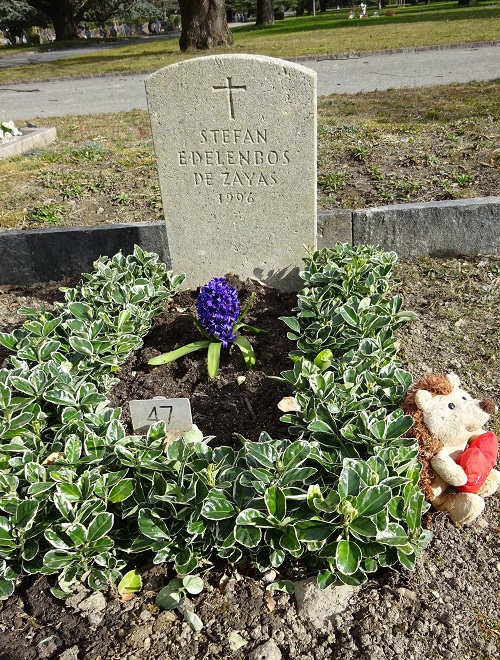
10 Feb. 11:30 a.m. Ivo Petrov dies at the hospital. We will miss him dearly. Pulvis et umbra sumus (Horatius, Odes)
9. Feb. lunch with Lucas Precoda at the GSD restaurant in the Octagon -- leave 5 bags of books that I make available to my students
7 Feb. - see cardiologue for the quick test - 2.2 -- go to PN to discuss thesis with Cesar.
6 Feb - first day of teaching at GSD/Octagon
5 Feb - Ivo suffers cardial arrest, we visit with his mother, wife, Victor, Joro at the HUG intensive care unit in the new building
4 Feb. drive back to GenevaJ
3 Feb. - ski in Belalp
2 Feb - dinner with Manuela and Marcellus
1 Feb. - ski in Riederfurka, Riederalp, Moosfluh, Hochfluh, Bettmerhorn with great views of the Aletsch glacier
31 Jan ski in Saas Grund
30 Jan - ski in Belalp
29 Jan - lunch with Marie, Daniel & Jean. Drive to the chalet
27. Jan -- Ex Tempore salon at home.
26 Jan -- saw Ms Baragan at the Octagon campus of GSD where I also met with Cesar to discuss his dissertation on China-US rations.
18 January 2023 arrive at 6 p.m. in Geneva, totally jet-lagged
17 January -- go to Chase bank and try to fix the 50 dollar charge. Fly at 9 p.m. from Miami international airport to Amsterdam
Monday 16 January -- return our Honda to Budget rent-a-car. Pepin picks us up and we drive to the Keys. Swim after the 7-mile bridge
Saturday14 January -- drive in my Honda with Carla, Pepin and Vicky for lunch at George's .-- I swim in their swimming pool.
Friday 13 January -- return to Coral Gables after visiting the Bok tower and gardens at Lake Wakes
Thursday 12 January -- swim in the hotel pool at St. Augustine, drive to Winter Park (visit the Morse collection/Tiffany museum), Lake Afred, and Lake Wales where we stay at the Holiday Inn and eat in the Suite -- with a wonderful bottle of Australian wine. Also swim in the hotel pool.
Wednesday 11 January -- leave Pensacola at 9 a.m., drive to St. Augustine, arrive at 3 p.m. eat a Ben & Jerry's Cherry Garcia ice-cream. Buy a bottle of California wine with a screwtop (forgot to pack a bottle-opener), had dinner overlooking the swimming pool.
Tuesday 10 January -- celebrate Pepin's 77th birthday by driving to Pensacola beach and eating -- for the second time -- in Peg Leg Pete's -- again I had baked oysters. Had my best swim in Pensacola beach. Sent out my 50 Theses on the Expulsion to Benjamin Karp, bought a second-had lense for Carla's camera.
Monday 9 January -- leave New Orleans and drive the coast, stop in Biloxi, get my feet wet on the beach, ate pizza overlooking the Gulf Coast, drove on to Pensacola.
Sunday 8 January - get terribly wet in the rain in New Orleans, visit the French Quarter and have an Irish Coffee at the "Carrousel" of the Hotel Monteleone. Lobster dinner with Ben's parents at their magnificent dinner table on Versailles Avenue --
Saturday 7 January leave Pensacola and drive over Mobile Alabama and Biloxi to New Orleans. We stay with Ben Karp's parents -- lovely old house on 3 Versailles Boulevard in New Orleans, not far from Tulane and Loyola Universities
Friday 6 January -- go to Pensacola beach, have lunch at Peg Leg Pete's and then go for a swim.
Thursday 5 January -- too cold to swim in the pool at the "Moorings", the motel on the marina. Drive over the bridge to Apalachicola, where we tank and take a walk around the old town. Arrive in Pensacola after getting our feet wet in Mexico beach, Panama City Beach (red flag because of rip) and Gulf Breeze. Amost landed on Highway 10 which would have been a big mistake. Drove on Scenîc Drive up to Langley and then Keystone.
Wednesday 4 January -- Good breakfast at the Holiday Inn, prepare two bagel sandwiches for lunch. Tried to see the manatees without success. At the Three Sisters National Park (20 dollars per person, so we did not go), there was very low tide and the manatees had moved to deeper waters. Instead we stopped at the Archeological Park, where Carla saw manatees just getting their noses above water to breeze. The view from the "hill" made out of millions of oyster shells, there was a wonderful view over the river and the bay. Then we went for a walk along the river and -- I think -- I saw an aligator. Get into a rainstorm and stop near Perry for lunch at a very typical restaurant. The area is dotted with churches -- The "Church of God", "Church of Christ", "Church of the Resurrection", "First Baptist Church", etc. Go into a "Dollar general" store and buy sunglasses, since I had broken the plastic sunglasses I had bought at the Etos in Noordwijk.
3 January -- from Sarasota North -- via the St. Petersberg bridge, to the Dali museum and on to the Homosassa Springs National Park, where we saw manatees, panthers, bears, wolves, foxes, flamingos, pelicans, "love birds", the "bald eagel" -- that can no longer fly because it lost part of the left wing in an accident. On to Chrystal Springs -- where we stay at the Holiday Inn and take a did in the pool. Lovely dinner at Cracker's fish restaurant -- had "Gator bites" and crab cakes with beer.
2 January 2023 -- stay at the Holiday Inn where the pool is very pleasant. The water is undrinkable -- tastes of sulphur. So we let the ice from the ice machine melt and then drink that instead. See an aligator at Lake Okeechobee and plenty of exotic birds. Drive from Clewiston on to Sarasota -- dinner with Eduardo and his wife Janet
1 January 2023 -- lunch at Geroge & Kim's -- and also see Zack. swim in the pool.
31 December -- eat lobster for New Year's
30 December -- George takes us in his boat out to Flamingo on the Everglades, Spend 4 hours watching crocodiles, shark, dolphins, pelicans and manatees, pick up plenty of Jacob's shells at a deserted beach.
28 December -- Carla and I both get a haircut. Go to Books and Books. I order Martin Luther King Jr.'s "Why we can't wait". Vicky drives us to Key Biscayne for the sunset and the Lighthouse at Bill Baggs National Park.
Tuesday 27 December -- fly to Miami via Amsterdam
25 December -- watched out "cult" Christmas movie "The Holiday" with Cameron Diaz and Kate Winslet.
24 December -- visited Ivo, who is convalescing at home.
20 December -- already somewhat better -- visit my doctor Sakbani. sleep a lot
19 December -- down with the flu -- 39 fever
18 December -- successful Christmas concert at St. Hyppolyte. Paul and MariRose were quite plesed. On the way home started trembling like a leaf.
15 December -- pick up Ex Tempores at the printer, cycle downtown to the notary Claude Terrier to sign our last will and testament with Carla.
11 December -- visit Gerlinde Lenz in Herrenberg. She is fighting bone cancer.
10 December - international human rights day -- statement for the Tamils in London - travel to Tübingen to receive the "silberbesticktes Band", an honour for having been a member for 50 years.
9 December - first snow of the season - some 13 cm in the North Garden -- but it has started to melt. It is 2 degrees C now.
6 December -- our 26th wedding anniverary -- while we are already 30 years together. Celebrated with Paul and MariRose after the choir rehearsal.
25 November -- propose a "Global pact on education" to the Chinese mission. Lunch of the seniors at the Chapelle des Crêts. Side-event at the HRCouncil with David Lopez on my 25 Principles of International order.
24. November -- lecture at Uni Mail on migration -- invited by assistant professor Julie Franck 80 students, good questions
23. November -- lunch with Prof. Nicolas Levrat at the University of Geneva. Concert at Victoria Hall -- Hector Berlioz' Romeo and Julia.
22 November -- Pablo Milanés dies aged 79 in Madrid
17 November - spoke to DG Taniana Valovaya and to former Czech President Vaclav Klaus at the Crans Montana Forum at the Fairmont Hotel in Geneva
15 November - visit Stefan's grave -- he would have been 26 years old -- and attended the funeral of René. Idelette's husband, at St. George cemetery.
8 November - second rehearsal for the Christmas concert.
7 November -- finally, the 2 recalcitrant tortoises dug themselves in and started hibernation. The bigger one dug herself in two weeks ago.
4-6 November - hiking on the Simplon down to Engeloch and uphill from Egga..
1 November - started rehearsals for the Noel Oecumenique. Paul and Marie Rose joined the ranks of the sopranos and tenors.
31 October - published in Counterpunch my essay on Shakespeare today.
19-30 October -- visiting family and friends in Holland. Balmy weather, swam four times in the North Sea. Flew my kite, watched the kite surfers, visited the archeological museum in Leiden, the Laakenhal and Naturalis.
11 October -- go with Martin to hear Harro von Senger lecture at the University on the 36 Stratagems
7 October -- Crimean bridge attacked. Give interviews to CGTN and Xinhua.
5 October -- panel at UN on self-determination
25 September -- quick trip to the chalet to save the harvest before we go to Holland.
10 Sepember - Mozart program at the Musikverein. Dinner at the Bristol.
9 september - meet Prof. Jeff Sachs and his wife Sonia at the restaurant Dots
8 September - fly early morning to Vienna
4 September -- Elizabeth and Ned leave by train for Milan/Mondavio.
3 September -- Ned, Elizabeth's grandson, arrives by plane from Brussels -- they lost his luggage.
2 September -- lunch with Elizabeth & Kate Fox at the Perle du Lac. Go to Palais des Nations and speak long with Peter Splinter and Alena Douhan.
31 August -- pick up Elizabeth Evatt at the airport
30 August -- Mikhail Gorbachev dies in Moscow, aged 91. A tragic hero. I met and spoke to him in Russian during the weeklong conference at Bosco Marengo back in 2009. He left an indelible impression.
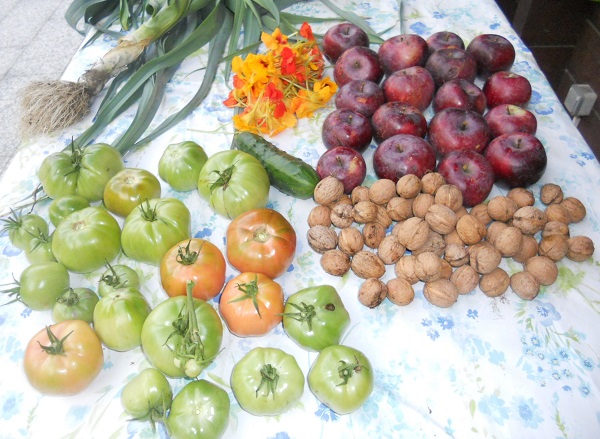
27 August -- harvest 42 tomatoes, 2 cucumbers, 2 leaks and some 20 kapuziner Kresse
26 August - cycle to Ornavasso and Domodossola and return via the Simplon back to Moos
25 August -- visit the pilgrimage church of Sta. Catarina (of Alexandria) del Sasso, cycle on to Lago de Mergozzo
24 August - take the telesiege to Cimeta, meet some nice Indians -- from India -- cycle on to Luino in Italy
23 August -- cycle down the Leventina, Giornico, Biasca, Locarno and take the telecabine to Cardada
22 August -- cycle up the Nufenen Pass 2477 m
14. August - my friend and colleague Alessio Bruni dies of a sudden heart attack
1 August - travel back to Geneva, Stefan would have turned 26 years old
31 July drive from Noordwijk as far as Luxembourg South
8 July -- Go to celebrate the 18th birthday of Hidde, son of Marieke and Brecht, who shares his birthday with Mahler.
7 July -- Mahler's birthday.
5 July -- the family comes over to Noordwijk to celebrate Carla's 64th birthday.
30 June -- arrive in Brielle and deliver Henny's bike
29 June -- drive over the Jura to Le Parsey where we stay in the Logis de France on the shore of La Loue and swim in La Loue.
21 June -- Ed Snowden's 39th birthday. Sommer solstice for us in the North. Winter solstice for those South of the Equator.
18 June -- lovely literary afternoon at the Casino of Rolle, my legacy to PEN Suisse romand -- having initiated the Rolle tradition during my first year as President of PEN Suisse romand in 2006. I read some of my translations of Rilke and Hesse.
17June - Henny arrives on her ebike from Holland -- Carla went to meet her in Biel and they cycled the rest together.
June -- continued celebration of my 75th birthday. Pop our own bottle of Veuve Clicquot to accompany the smoked salmon.
31 May -- ritual swim in lake Geneva and birthday luncheon at Chateauvieux -- with Krug champagne.
18-29 May - visiting Martin in Prague & Czech republic
27 April - ¨Koningsdag -- we put out the Dutch flag and drink an orange Aperol, since the traditional "Oranjebitter" was not available at Schiphol airport.
12-23 April flew to Holland for the Easter holidays.
2 April - ceremony at the crematorium in Veldhoven: Our minds are alive with images and sounds of family and friends who have departed. In us and with us, their presence sometimes seems as real as that of those who are physically around us. In our conscience there are voices, we see the colour of their eyes, feel like we could touch them, make a rendez-vous, chat about the weather. We raise our eyes, look at the blue sky, focus on the horizon over the immensity of the ocean. We remember them. Violet memories embrace our deceased parents and siblings, our uncles and cousins, childhood friends and acquaintances, just as if they were still alive. Orphans that we are, lost at our inability to connect, at our unrequited desire to speak with them again. We only see them in our mind's eye, disconcerted by this merciless realization. One day, when we are no longer physical -- we will perhaps inhabit the memories of those who remain behind.
1 April - drive to Holland ans stop over in Le Parcey, on the shore of the river La Loue that then empties into the Doubs
27 March -- sad Sunday -- just learned that my favourite brother-in-law, Cor, Carla's 71 year old brother, died suddenly of a heart attack. He woke up this morning fine, started feeling off, and he left us. We will fly to the funeral in Veldhoven.
26 March -- Te Deum laudamus - my 3 tortoises wake up after four and a half months in hibernation. Alleluia!
23 March - travel to Basel and Bettingen
19. March -- After 13 wonderful days of skiing, the season is now over, and we are ready for cycling
2 March - GSD debate on the Ukraine war. - immediately after Carla and I left for the chalet.
24 Feb- Russia invades Ukraine. God help us all.
20 Feb - watched the closing ceremony of the Beijing Olympics. Impressive. Happy with the 7 gold, 2 silver and 5 bronze medals for Switzerland.
7 February - first day of my masters class at GSD - international law again
5 February - my interview with Galloway is broadcast.
4 February - funeral of Stavroula Peschou-Uhlig, our dear Rouli at St. George.
30 January - Rouli dies of stomach cancer.
24. January - publish an essay "Nato as Religion" in Counterpunch. Give an interview to George Galloway on my book.
20 January -- give TV interview to Russian Channel 1 at the Hotel President Wilson -- on the Friday meeting between Blinken and Lavrov
14-15 January 2022 - skiing in Saas Grund and Bettmeralp/Riederalp
3 January 2022 -- return from Piégon after 4 days of intensive olive harvest with Daniel and Marie Neeser, with whom we also celebrated the St. Sylvester.
30 December - plant 20 tulips in the garden -- drive to Piegon, France to start the olive harvest with the Neesers
29 December - visit Ivo at the clinic
28 December - visit Marieke and family in Le Carroz, France
25 December - chamois Christmas dinner at home
23 December - glorious day of skiing in Belalp -- over 5 hours
21 December - winter solstice
20 December - GIPRI meeting, suggest colloquium on human rights and the human rights industry, ski in Crozet/Lelex
19 December - go to the cemetery to visit Stephan's grave. Sing concert at St. Hippolyte - serve Glühwein
17. December - publish interview in Counterpunch -- and go skiing at La Clusaz.
16 December - give interview to Gregor Puppinck of the European Centre for Law and Justice. Carla and I ski in La Clusaz
13 December -- give the final exam to my students. Have a nice chat with Lucas -- I'm sure he's an A.
12 December Hans-Jörg and Lea come for a Paella lunch, followed by a wonderful performance of Georges Bizet "Les Pecheurs de Perles" at the Geneva Opera.
1 December - baked a bread with nuts -- 950 grams.
30. November -- fifth rehearsal for the oecumenical choir. Hope we won't have to cancel the concert because of Covid.
27.November - did the culte at the Chapelle des Crêts, based on Luke, chapter 1, and the "Angelus". Followed by a concert with Marie Neeser and Eric Noyer. Interview with Going Underground
19 November - Nicaragua has decided to leave the OAS, this discredited sold-out organization complicit in the coup d'état in Bolivia in 2019 and in so many other imperialistic and colonialistic adventures, this pathetic tool of the US State Department, headed by the disgraceful lackey called Luis Almagro. Amazing the deliberate subversion of the fundanmental values of the American Convention on Human Rights -- precisely by the organization that should be advancing those values. Another example of Juvenalis' constitutional question quis custodiet ipsos custodes? Who will guard over the guardians? I think it is time for Bolivia, Mexico, the CARICOM states to leave this decadent outfit and strengthen instead the CELAC - the Community of Latin American and Caribbean States, which was founded in 2011 and better responds to the sovereign needs of Latin America -- that's where the future lies.
went with Carla to a theater piece in Genthod -- everybody wearing masks. Beautiful full moon!
17. November - publish an article with Adriel Kosonta on the migration crisis in Poland/Belarus
14 November - Martin is visiting his mother in Ornex, so he came over for dinner and spent the night. It is as if he had never left. We just picked up where we had left off.
2 November - rehearsals of the oecumenical choir start for our traditional Christmas concert. We are only doing five carols this season, and only five tenors signed on -- I do not know any of the songs, one of them in Rhaetoromasch language, but happily the tunes are rather easy hold
in the morning did an irm test and it turns out that decades ago I had a virus that left a scar on my heart, thus disrupting the electric impulses and now causing arythmia - nothing to do but live with it -- thank God it is not too serious.
31 October - All Hollows Eve -- spend all day working on my photos to prepare a 2021 album.
23-27 October -- lecturing in Poland, dinner with Theodore Meron
14 October - our three tortoises have decided it is time to hibernate and all three have dug themselves in -- so won't see them until next March, Deo volente.
13 October -- lunch with the Ambassador at the residence in Bern.
10 October - concert of Marie Neeser and Eric Noyer at the chapelle des Crêts
7-8 October - discover Appenzell Innerrhoden and Ausserrhoden
3 September -- walk around the Blausee park and take the little boat ride. Take a 3 arrow cycling route to Kandersteg and have a coffee at the Rüdihus, where we celebrated my birthday in 2008.
2 September - soft cycling down to Interlacken, swim in Faulensee beach on Thunersee, just under the Niessen, cycle on to Blausee -- nice hotel, but overpriced -- and my "Forelle Blau" was uncooked -- sent it back for another swim in boiling water. then it was tasty.
1 September -- Unterbach falls, Giessbach (awful 3 arrow climb to avoid the road and the tunnel, 20% descent on lake Brienz) take a swim at Brienz, continue to Lauterbrunnen -- absolutely spectacular place. Goethe wrote a poem about it -- me too.
30 August - early out to climb the Grimsel Pass -- actually quite easy, but very cold at the lake. The descent was even colder, especially in the tunnels. Very impressive walk in the gorges of the Aare, arrive tired in Meiering, supposedly the origin of Meringues, and famous for its Rheinbach falls where Conan Doyle's Scotland Yard's inspector Sherlock Holmes dies flighting Professor Moriarty. The St. Michael's Church is worth seeing -- excellent excavations of the 10th century church.
29 August - start cycling tour -- very tough 3 arrow climbs to Grengiols, Ernen -- the rest to Gletsch were 2 arrows, stay the night at Hotel Rhonequell
22 August -- one shooting start -- in Geneva !!!
19 August -- hike to the Fiesch and Aletsch Glaciers
18 August - John Tyndall walk and swim in Lüsgersee -- 1 shooting star
17 August - hike from Kreuzboden to Saas Almagell. 2 shooting stars
16 August - hike from Wiler to the Schwarzsee in Lötschental. 3 shooting stars
15 August - rainstorm and clowdy -- no stars.
14. August - swim in the Hopschuseee at the Simplon Pass. 5 shooting stars
13. August - concert in Ernen, walk to the Twingi for the art exhibition. Both Carla and I lay in the back terrace and watch shooting stars -- ten each.
10. August lunch with Bruna and Rosita at Port Gitana
8. August -- Carla and I cycled two hours through the "art en campagne" exhibit in Collex-Bossy/Ferney-Voltaire/Ornex -- I have to write a photo-reportage for the New Special.
7. August -- visit the Metz Cathedral, drive through Epinal, Besançon, Arbois. Stop in Le Rousses to buy some food -- quenelles de brochet --
4 August -- cycle to castle Duivenvoorde -- get caught in a magnificent rain stort -- great pictures
3. August -- cycle to and around the Kaagse Plassen
2. August -- cycle to Zaandvoord to admire the sand sculptures and see some magnificent deer in the dunes, not far from the cycling path.
11-19 -- cycling the Dutch Hanse towns on the Ilsel river, visit Astrid and Cees in Ruurlo.
2 July -- arrive in Noordwijk in lovely weather
1 July -- Carla and I drive to Heidelberg to see Peter Macalister and continue to Noordwijk aan Zee.
30 June - Human Rights Council side-event on Colombia. IACHR commissioner Luis Vargas was excellent. Later did 14 pots of yellow plum jam and 16 pots of red plum jam
28 June - gave interview to the Council of National Resistance in Iran on Ashraf III, and an interview to Sputnik on Assange
27 June - graduation at GSD, talked a long time with Dr. Tedros Gebreyesus, who was awarded a Doctorate honoris causa.
Since we could not hold our traditional Ex Tempore Salon (Covid) in January, Carla and I decided to organize a 'literary tea party'' in the North Garden at our home in Grand Saconnex. Participation was limited to 15 persons so that we could guarantee the proper distance -- besides being in the fresh air. Admittedly, not as buoyant as an Ex Tempore soirée, this more intimate event allowed UNSW members to read some poetry, short stories and essays. We had excellent weather and plenty of coffee, tea and other non-alcoholic drinks. We transformed the ping-pong table into a grand buffet -- one person at a time. Among participants were Marie-José Astre Démoulin, Aline Dedeyan, Martine Thevenot, Jo Christiane Ledakis, David Lewis, Hoang Nguyen, Boris Engelson, Pierre Jourdan, Josep Gari, Patrick Taran with his wife Olga and 2 very lively youngsters.
25 June - harvest rucola and radishes from our vegetable garden in Moos.
14 June - concert recital -- live !!! -- at Salle Frank Martin at the collège Calvin in the old town of Geneva, with pianist Nina Uhari accompanying soprano Aurélie Jarjaye and mezzo-soprano Stéphanie Guérin, singing arias from Bellini, Berlioz, Massenet, Saint-Saens -- and a new one to me, the 19 century soprano, composer and companion of Ivan Turgeniev -- Pauline Viardot (1820-1910), whose bicentenary we are celebrating. She even sang for Wagner and Hector Berlioz!!!
9-10 June -- brilliant conference on unilateral coercive measures with Prof. Alena Douhan, Prof. Jeffrey Sachs, Richard Falk, William Schabas, Mark Weisbrot -- excellent conclusions by Ambassador Hector Constant and closing statement by Dr. Collum Murphy, President of the Geneva School of Diplomacy
31 May -- birhdays are occasions to acknowledge prior generations, celebrate our parents and grandparents, count our blessings
28 May -- first cycling tour of the season -- 71 kl. to Luins and back in perfect weather.
27 May -- Palestine Special Session. I record a 90 second message on behalf of the International Human Rights Association of American Minorities, do a 3 hour broadcast in Morges for Swissbox conversations, a Swiss-French podcast.
25-26 back to the chalet -- up to the village of Grengiols to admire the Tulipa grengiolis, which only grows there -- in 3 varieties.
13-16 May - hiking holiday over Ascension -- with Carla and Daniel/Marie Neeser. We discover the Kappel Monastery, its magnificent 13th century church and cloister and the oldest stained glass windows in Switzerland. Then off to Zürich to the Marc Chagall windows in the Faumünster. Also took a dip in Türler lake near Hausen.
11 May - received my second Pfizer jab
9 May we drive back from the chalet and take a 2-hour hike at Les Avants over Montreux to admire the "narcisses du poète" -- the snows of May
2 May -- Orthodox Easter, congratulate Rouli and Ivo Petrov (who is at the Hôpital de la Tour after open heart surgery)
26 April - all-day expert meeting with Prof. Alena Douhan -- met very interesting professors and economists.
25 April - Christa Ludwig, my favourite mezzo-soprano passed away at age 93. I met her backstage after a performance of Rosenkavalier, in which she played the Marshallin. But I had also seen her in the role of Octavian, and particularly appreciated her Lieder -- whether Richard Strauss, Gustav Mahler, Richard Wagner -- a truly great lady. I have several autographs from her. Difficult to say what I like most -- maybe "Morgen" by R.S.
24 April -- 106 years ago began the Ottoman/Kemalist genocide against the Armenians, Greeks of Pontos and Smyrna, and other Christian minorities
23 April -- published in Counterpunch my essay on genocide -- together with Professor Richard Falk
13 April -- just got my Pfizer-jab. So far so good, although there is always a danger with vaccines -- they warned me of the possibility of headaches and slight fever. Our garden is bursting with flowers and the 3 tortoises are timidly walking about, because although it is sunny, the temperature is around 9 degrees centigrade.
10 April -- the best US Attorney General -- Ramsey Clark -- passed away today at the age of 93. Tragic how he was marginalized by the mainstream media because he inisted on transparency and accountability and started saying the truth about Vietnam, Iraq, Libya, Syria --
8 April -- took the Löschberg car train from Gampelsteg to Kandersteg, drove along Thunersee and Brienzersee to Lungern, where we visited the churches and towers of this old Obwalden community.
7 April -- Nadia Stouffs died of cancer at the age of 80. She enriched my life, will cherish her memory forever.
2 April -- just saw that my publisher, Clarity Press in Atlanta Georgia, is advertising my book "Building a Just World Order"
https://www.claritypress.com/product/building-a-just-world-order/
1 April -- first aspharagus of the season
23-24 March -- we skied like youngsters in Belalp and Hohsaas. During this season Carla and I enjoyed twelve full days of skiing skiing -- mostly between five and six hours -- and the last day at Saas Grund we skied for six hours and ten minutes, took lots of photos and made videos.
15 March -- on the Ides of March we think not only of Julius Caesar -- I also give my students a mid-term exam and cook a chicken. It rained all day.
12 March -- snow-racketting on the Simplon, from the pass to the old Stockalper Hospiz.
10 March - skiing in Saas Grund -- six full hours -- but such good snow -- neither Carla nor I had muscle-pain. My pre-recorded messages for the inter-active dialogue on Item 4 were broadcast. I uploaded them on my blog.
5 March - Pope Francis is in Bahgdad -- corageous man! This morning one of my 3 tortoises woke up from hibernation. the other two are still sleeping. Went to GSD to record 2 statements on behalf of IHRAAM for the HR Council.
26 February - our best PEN Suisse romand poet, Philippe Jaccottet, died at his home in the Drome Provençale at the age of 95. RIP
18 February - my very dear friend Luz Stella Cuellar-Moreno died at the age of 72 of coronavirus in Bogotá after a month in intensive care. RIP -- Pulvis et umbra sumus Horatius, Odes, Carmina book IV, 7, 16.
17 February - Ash Wednesday. Memento homo, quia pulvis es et in pulverem reverteris.
5 February -- Christopher Plummer (captain von Trapp) passed away at the age of 91. ICC takes jurisdiction over the case concerning Israeli war crimes in Palestine.
1 February -- spring semester begins at GSD -- I have 17 students in my masters course on core principles of international law (alas online). Otherwise Carla and I are spending a lot of time with puzzles -- a highly addictive occupation.
30 January -- Professor Alena Douha starts her mission in Venezuela
26 January -- zoom meeting of the AHSC Lac Leman.
22 January -- our dear friend Jacqueline Berenstein Wawre passed away at the age of 99
14-17 January -- skiing -- splendid blizzard on the Simplon
2-8 January 2021 -- skiing in Belalp, Bettmeralp, Riederalp. 100th brithday of Friedrich Dürrenmatt, see "Der Besuch der alten Dame" with Maria Schell on Swiss-german TV.
1 January 2021 -- Neujahrskonzert from the Musikverein in Vienna. A tradition we keep and cherish. Ricardo Muti conducting (born in Naples 1941). Music is indeed a mission of hope, beauty, love. Culture is life -- thus,I Prosit Neujahr! We particularly enjoyed Johann Strauss II's Opus 314 -- the Blue Danube -- Opus 410 -- Frühlingsstimmen -- and Opus 437, the Kaiserwalzer. Muti even played a Strauss Quodlibet with Verdi melodies.
31 December -- it snowed this morning. We count our blessings notwithstanding the turmoil of this annus horribilis that has brought so much suffering to so many. Carla and I kept safe and healthy -- thank the heavens -- but many of our friends did not. We missed the joys of being together with others, sharing jokes, singing in the oecumenical choir, going to concerts, participating in social events, visiting libraries and musea, eating in restaurants. I had to get used to lecturing on the internet, I saw my students on the screen, but could not exchange views in the customary way. Bizarre the new body language, and the way we keep distance from others. I miss shaking hands, patting friends on the shoulder, laughing out loud. We are all hopeful that 2021 will allow us to resume some of those activities that make life more meaningful. Carla and I spent the afternoon baking "Oliebollen" -- the Dutch specialty, of which we prepared more than 70 beignets, some with apple, some with raisins, some with candied fruit. Visited my former Dutch teacher Jos Levy and brought her and Danny 7 Oliebolle for good luck in 2021.
26. December glorious winter weather -- minus 3 degrees, beautifully sunny, very clean air -- perfect for the fireplace, and no smoke at all came into the room.
25. December -- Pintade (guinea fowl / perlhuhn) for Christmas dinner. Listen to the inspiring Urbi et Orbi by Pope Franciscus.
21. December -- winter solstice -- and the great conjunction of Jupiter and Saturn. Carla and I were able to observe it on the South-West.
100th anniversary of the birth of the great Cuban ballerina Alicia Alonso, who passed away at the age of 98 on
17. December -- give webinar at the Univesity of Geneva. 250th anniversary of the Baptism of Beethoven on 17 December 1770.
13-16 December -- skiing in Belalp, Riederalp, Bettmeralp
7. December -- my last lecture for the semester. I will miss the kids. Listened to Ariadne auf Naxos with Jesse Norman and James King on Met Opera on Demand.
6. December -- Second Advent -- AND our wedding anniversary!
1. December. Delivered to the printer the usb key containing the new Ex Tempore 31 -- hoping for copies next Monday.
29. November -- Walküre on "Met Opera on Demand". Brilliant production by the Canadian playwright Robert Lepage with Christine Goerke (American) as Brünnhilde, Greer Grimsley (American) as Wotan, Eva-Maria Westbroek (Dutch) as Sieglinde and Stuart Skelton (Australian) as Siegmund. Beautifully staged and sung. Wish that Bayreuth would go back to intelligent staging and not continue "auf dem Holzweg" with pseudo-modernism, which is but an expression of nihilism.
11. November -- St. Martin's day. Elizabeth Evatt's 87th birthday. Annual general assembly of the United Nations Society of Writers. Meetting with the Turkish ngo.
8. November -- it's Biden. Not much change, alas, since the Republican and Democratic parties converge in essentials -- militarism, exceptionalism, interventionism, unilateral coercive measures (sanctions), induced "regime change" in foreign countries, mass surveillance of citizens, the war on whistleblowers, the arms race, the military-industrial complex, weapons sales to Saudi Arabia and other rogue States, Wall Street over Main Street, bailouts for big banks and financial institutions, anti-Palestinian defamation and dis-information. For me the "default position" of both parties remains a form of 21st century imperialism. When will the US electorate ever get a genuine choice between a candidate who favours international peace, solidarity, development, education, health care, multilateralism and respect of international law and conventions -- and a candidate who overtly or covertly repudiates international law and actually nurtures conflict?
7. November long hike from Rothwald to the Wasenhorn.
6. November long hike along the Aletsch glacier.
5. November long hike with Carla on the Simplon Pass.
3. November -- US election undecided. I voted by absentee ballot, but neither for Trump nor Biden, because that's a choice between bad and very bad. I registered a "protest vote" -- as I did 2016 -- voting for a "write-in" candidate.
31. October -- Sean Connery passed away at the age of 90.
29. October -- cut a big pumpkin and put it on our window for Halloween. Held our AHSC Lac Leman meeting per videoconferencing.
17. October -- marche meditative around Plan le Ouates and Compessières
15. October -- all 3 tortoises are now hibernating.
10. October -- conference on sovereignty and sanctions in Bern. Drive with Gilles-Emmanuel Jacquet.
6. October -- lecture per zoom at the symposium in Berlin "75 Jahre Vertreibung"
5. October -- my student from Mumbai did a good oral presentation on the Peace of Westphalia.
4. October -- give zoom interview to Armenian TV on the Azeri aggression against Nagorno Karabagh
3. Oktober -- Nozze di Figaro in Met Opera on Demand.
30 September -- did 5 kilos of membrillo (pâte de coing) and some 30 pots of quince jelly.
18. September -- hike up the Tyndall monument on the Belalp. Again shooting stars over the chalet. Carla and I swam in Lüsgersee (2100 m), 14 ° C.
17. September -- saw shooting starts over the chalet. Swam in Hopschusee on the Simplon Pass (2018 m), 15 ° C.
21 August -- bbq followed by spectacular star watching, but only saw two shooting stars.
20 August -- dinner with Marie & Daniel Neeser and Jean Gaeng
19 August -- Eugene Onegin in Met Opera on Demand
18 August - cycled from Vercorin to Grimmentz -- lots of up and down.
16 August -- cycled through the Loetschenthal to Fafleralp and swam in the Schwarzsee.
8 August -- just got the happy news that today, Saturday, our two pigeon chicks fledged. They flew away from our balcony in the afternoon and never came back. Here the last two pictures of our "guests". All through June and July we hosted the nest and the little family of pigeons -- first discovered the nest, then the 2 eggs, then saw them hatch, and grow day by day until our departure on 28 July. Life goes on ! Now, of course, we have to clean the mess !
.jpg)
6 August -- returned from the chalet.
1 August -- Stefan would have been 24 today.
28 July -- return to Geneva driving through Wiesbaden, where we meet Eberhard an Won Hi at the Kurhaus. Back from Holland after nearly 5 glorious weeks of cycling, swimming, and enjoying good fish.
23 June -- meeting with Alexander at the Ariana restaurant. Inteview to Adriel Kasonta for CGTN
22 June -- what a harvest ! do some 20 pots of green plum jam, 25 pots of red plum jam, 15 pots of cherry jam
14-16 June -- hiking in the Valais
8 June -- interview to Brazilian journalist
7 June -- drive back to Geneva. It is so cold, that we do a fire. Watch Met Opera on Demand -- Othello.
3- 6 June -- hiking in the Valais.
31. Mai - 1 June -- celebrate my birthday at Münchenwiller, a Cluny Abbey near Murten. Swim in Geneva, Murten and Neuchatel lakes.
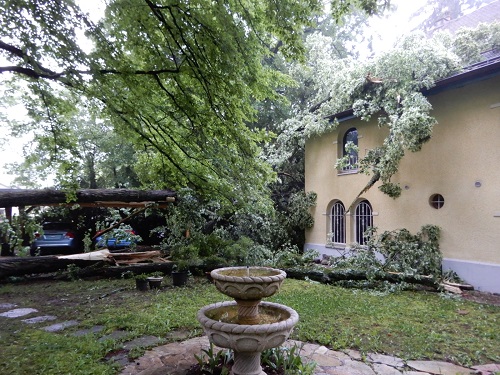
13. Mai -- at 2:30 in the morning Carla and I woke up because of what we thought was explosion -- not quite. One of our lime trees, the Lindenbaum sung so often by Schubert and Mahler -- fell on the house. A 45meter beauty, in perfect health, gorgeous fresh green leaves. Happily it only hit the side of the house and caused plenty of damage, but a direct hit in the middle would have been devastating.
5-9 Mai -- hiking in the Valais --
2. Mai -- watched Met Opera on Demand --the magnificent 1985 performance of Leontyne Price as Aida. Wow!
27. April -- Koningsdag -- put out the Dutch flag. Gave skype interviews on sanctions to Norwegian journalist, on Covid to Asia Times.
21-25 April -- hiking in the Goms, the Stockalperweg, the Saltinaweg, the Kettenweg and enjoying perfect spring weather.
15. April -- listened to Boris Godunov with Rene Pape singing Boris.
14. April -- opened an abonnement with Met on Demand and listened to the full opera Adriana Lecouvreur with Anna Netrebko as Adriana. Sublime!
12 April -- Easter Sunday -- beautiful weather, but Mass and Urbi et Orbi only on TV
5 April -- Palm Sunday. Cut a branch of our palm tree and attached it to the front door. Benedictus qui venit in nomine Domini. Enjoyed a lovely bbq in the garden.
27 March -- watched Pope Franciscus on television doing an unusual Urbi et Orbi homily and blessing from St. Peter's in Rome -- in an empty but radient Basilica -- only 5 priests were there, and the unseen choir singing Tantum ergo Sacramentum (or was it a recording? I sang it so often in the Glee Club) -- before a totally empty St. Peter's Square -- under the rain. It was at the same time eery and inexplicably beautiful. I always liked the dative declension of urbs (the town) and orbis (the globe) -- that wonderful wordplay invented by Ovidius in Fasti II, 684, an effective rhetorical device or paronomasia incorporated into the investiture of the Pope (investio te de Papatu Romano, ut praesis urbi et orbi) that renders the Catholic benediction ceremony a very special and familiar flavour since the practice began in the 13th century.
24 March -- gave an interview to Swissinfo on Covid and sanctions.
23. March -- gave my international law class over the internet -- and it worked fine. The 21 students listened and participated with questions and we could inter-act. Reminded them about the many conspiracy theories floating about Covid-19 and that, as Julius Caesar already noted in his de Bello Gallico 3,18 Fere libenter homines id quod volunt credunt, people believe what they want to believe.
20. March -- internadional day of happiness. Carla and I cycled to the Versoix river -- lovely weather here. Had lunch in the garden.
19. March -- first barbeque of the season. First hammock of the season. Enjoying the mild spring weather in the garden -- since everything is closed in town and even the UN library!
15. March -- elections to the Conseil Municipal du Grand Saconnex -- Carla was elected. We're popping a bottle of Ruinart.
Third turtle has emerged from the earth, but I am letting her sleep some more. Maybe tomorrow she's ready.
14. March -- the second turtle came out of hibernation -- still awaiting the resurrection of the third. What a miracle!
12. March -- went with Carla to Waldenburg in Baselland and gave an interview to Telesur on the issue of sanctions.
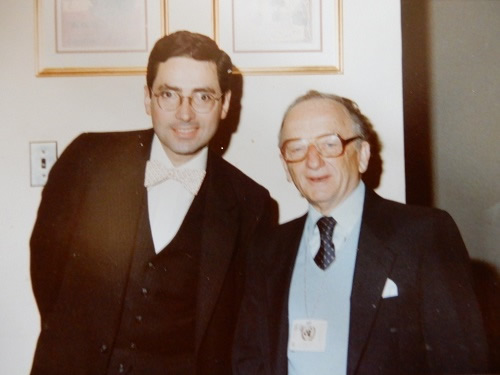
11 March -- my friend Benjamin Ferencz, whom I met many times at the UN, turned 100 years old today. Happy Birthday, Ben! Here an old photo at the UN Secretariat Building in New York in 1985. Ferencz used to come in and out -- even though he was super busy as a lawyer and professor, and as the foremost activist for the prohibition of the crime of aggression and for the recognition of Peace as a Human Right.
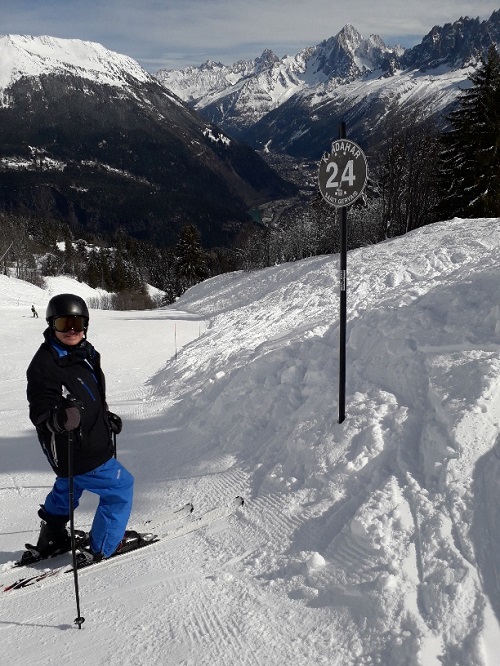
8 March -- superlative skiing. at Les Houches with a perfect view of the Montblanc. Took all the black pistes including the Kandahar, which is really a dark red, actually very easy, but I prefer the reds of the Bellevue region. The telekis are still difficult, they jolt you up nearly a meter. Kids must love it -- it's like an amusement park. The views from the telesieges are magnificent -- not only the Montblanc, but also the Aiguille de Midi, the Aiguille Verte etc.
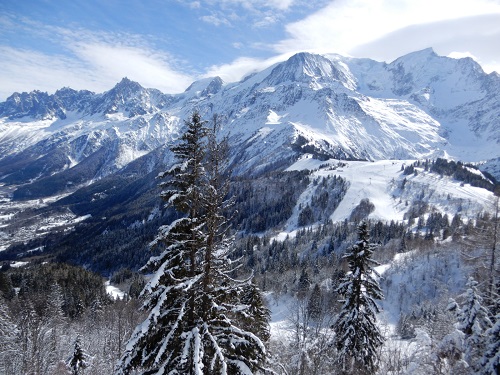
3-5 March -- skiing in Belalp and Grächen.
1 March -- wonderful Meissen exhibit at the Ariana Museum. Amazing exhibit and film at the Musée du Leman in Nyon on the devastating tsunami that took place 563 AD on Lake Geneva, when the whole side of a mountain collapsed into the lake at the level of St. Gingolf/Bret and caused a series of giant waves that devastated everything on their way down to Geneva. Actually, such a catastrophe could occur again, since mountains have become unstable because of global warming and permanfrost is not keeping the rocks together. Today, however, scientists monitor developments constantly and at least there would be "early warning".
29 February -- PEN general assembly in Fribourg
28 February -- drove to Annecy to attend Idriss' funeral. He was like an older brother.
LE RAPPORTEUR IDRISS JAZAIRY NOUS A QUITTE LE 27 FEVRIER 2020 A L'AGE DE 83
Idriss Jazairy, était pas seulement mon collègue en tant que Rapporteur Special des Nations Unies - il est devenu un vrai ami. On a publié ensemble beaucoup de communiqués de presse, on a partagé pas mal de panels aux Nations Unies et au Club Suisse de la Presse. Je l'ai invité et il est venu plusieurs fois chez moi aux soirées littéraires de la Société des écrivains des Nations Unies, que j'avais fondé en 1989. Il a publié dans notre journal Ex Tempore. Il possedait une grande experience et une plus grande sagesse, qu'il a mis au service des Nations Unies, à la defense de la justice, de la non-discrimination, de la reconciliation, bref - de la dignité humaine. Il s'est penché pas seulement sur les droits déjà codifiés, mais il nous rappellait les principes de justice qui constituent l'esprit des lois. Lorsqu'il était attaqué -- injustement et de façon diffamatoire -- je l'ai soutenu. Lorsque j'ai été calomnié, il m'a appuyé. Il avait enormément de courage et pouvez defendre une idée juste, même s'il était le seul à le faire. Bien sûr, Il était indpépendant -- mais aussi éloquent, élégant, convaincant -- et beaucoup plus important: Il avait une éthique, il était honnête et disait ce qu'il fallait. Nations Unis a perdu un vrai Rapporteur Special -- il va nous manquer.
27 February -- my colleague and friend, Ambassador Idriss Jazairy, Special Rapporteur on unilateral coercive measures, passed away today, he was 83, full of optimism and kindness to the end
14 February -- the NEW SPECIAL, the WHO publication to continue the UN Special came out with a nice article on Ex Tempore.
9 February -- the divine Mirella Freni passed away. Never forget her Mimi ! https://www.youtube.com/watch?v=CB46jziw7WM
31 January -- BREXIT. Gave skype interview to Telesur.
29 January -- burial service for Claude Citon. Our pastor Andreas Fuog celebrated at the Chapel of the Angel of Consolation at St. George's cemetery. Claude was buried not far away from the grave of our son Stefan.
25 January -- did the Saturday service at the Chapelle des Crêts, devoting the meditation to the Epistle of St. James, chaptes 2,4 and 5.
24 January -- Claude Citon (1938-2020), former editor-in-chief of the UN Special and frequent contributor to Ex Tempore, passed away this morning. We held a minute of silence at the beginning of the 24th annual Ex Tempore salon, which started at 19h and ended at 23h. There were 48 literature lovers in the audience and 15 readers in English, French, German, Russian, Spanish, and Vietnamese, peppered with Latin here and there..
3-10 January -- fly to Amsterdam to spend a week in Noordwijk, stroll along the North Sea, cycle through the dunes, visit musea in Rotterdam, Leiden and Amsterdam, get together with Walter Rabus and friends, eat great fish.
2 January -- delivered grades at GSD and picked up the newest edition of Malcolm Shaw's International Law, which I will use to teach this semester. Got the extension of my accreditation as representative of the International Human Rights Association of American Minorities.
1. January -- watched on TV (together with 55 million people worldwide !!!) the Neujahrskonzert at the Musikverein, conducted by the Latvian Andries Nelsons -- fantastic -- and olive picking before and after
28-31 December -- olive harvest at Piegon
24-27 December -- visit by Astrid Delissen and Cees van Beers, do a pintade for Christmas and, of course, cardon de Genève
22 December -- watch our dvd of My Fair Lady -- had not seen it for 10 years. What a pure delight!
18-21 December -- skiing at the Belalp
17 December -- visit the magnificent Christoph Blocher collection of Hodlers and Ankers at the Fondation Gianadda in Martigny
16 December -- lecture at the Geneva Business School on business and ethics.
15 December -- Oecumenical Christmas Concert at St. Hyppolyte. Brilliant -- notwithstanding my cough. Managed to hit all the high tones and did not cough once -- lovely post-concert reception. I brought a whole plate of pâte de coing (membrillo)
4-8 December -- conference in Athens on the Genocide against the Pontian Greeks. visit Parthenon and Acropolis.

2 December -- the anniversary issue Nr. 30 of Ex Tempore comes out -- start the distribution
1 December -- first Advent
30 November -- give interview to Swiss film-maker Stefan Ziegler on the future of human rights
28 November -- farewell for Felice Gaer of the Committee against Torture, reception at the Palais Wilson -- chatted with Felice and the HC
21-22 November -- lecture and panels at the Second Balearic Symposium on the development of international law
16 November -- Adventsmarkt in Salgesch
14 November -- PEN celebration of the writers in prison day
8 November -- General Assembly of the United Nations Society of Writers -- renewed the Board.
5 November -- lovely concert and debate at the Theatre de la Madeleine -- around Wagner, Strauss and Christa Ludwig.
30 October -- UN Christian Association reunion
26 October -- first rehearsal in the oecumenical choir
20. October -- gave an interview to Rafael Correa -- "conversando con Correa" on the situation of Human Rights in the world.
19. October -- gave a skype interview on the Ecuadorian crisis.
12 October -- last night someone stole Carla's ebike -- from the shed in the garden, even though it was locked. The house has an alarm, but not the garden!
11 October -- do 2 liters of quinces jelly and 3 kilos of pâte de coing.
10 October -- my old friend Waleed Sadi, member of the Human Rights Committee 1978-82, again 90 to 94 and then member of the Committee on Economic, Social and Cultural Rights, passed away during the session os CESCR here in Geneva. He loved Geneva and would frequently go swimming in the lake -- even last week !!! -- we will miss him. He was buried at 2 p.m. at the St. George cemetery, not far away from the grave of our son Stefan.
7 October -- the ANC delivers 60,000 signatures supporting a Petition to the Dutch Parliament concerning the Catalan issues, self-determination, political prisoners in Spain and the protection of Catalans as bearers of intangible world heritage -- We had a demonstration outside the Parliament in The Hague, where I gave interviews to Dutch journalists as well as EFE and El Pais -- https://doorbraak.be/nederlandse-petitie-wil-catalonie-op-politieke-kaart-zetten/
5 October -- meditation walk from the Chapel of Malval along the Alondon river
4 October -- Feast of St. Francis of Assisi https://www.youtube.com/watch?v=hro0LgppVpY
3 October -- hike along the Grande Dixence Dam -- dinner of pheasant and deer at Vouvry
2 October -- Carla and I hike from Binn to Fäld, do the stone walk past Serpentinite, Gneis, Dolomitenmarmor
1 October -- Carla nd I hike up the Moosalp
25 September -- participate as one of the experts before the Menschenrechtsausschuss des deutschen Bundestages -- on impunity
24 September -- speak on migration to some 30 Parliamentarians in Berlin
19 September -- panel with Kirk Boyd and Joshua Cooper
18 September -- spoke in the Human Rights Council on behalf of International Human Rights Association of American Minorities
16 September -- start teaching History 1500 to present. Tamara, one of my students, did a marvelous presentation on Antonio de Montesinos and Bartolome de las Casas.
15 September -- lovely swim in Lake Geneva.
14 September - visit geothermal UNESCO park in Reykjanes Peninsula. Flew out on time from Keflavik, arrived on time in geneva
12-13 participat in the local tradition of the Réttir -- or the bringing back of the sheep to the farms for winter -- saw some 4,000 sheep
4-7 september -- the Western fjörds are amazing.
1-2 September met with our former boss Justice Jackob Möller in Reykjavik and again died the "golden circle" including Thinvellir, Gullfoss, Geysir, and Kerid.
31. August -- Carla and I swim in lake geneva at 8 a.m. before flying to Iceland. Hope to hear Icelandic base Kristinn Sigmundsson
https://soundcloud.com/vikingur-olafsson/schubert-gute-nacht
30. August -- lovely swim in lake Geneva, at 8:30 in the morning. Fresh and all to ourselves.
29. August -- swim in lake Hopschusee at the Simplon Pass.
28. August -- cross the Hängebrücke over the Massa river, which empties the Aletsch Glacier.
20. August -- visit Harro von Senger in Willerzell
19. August -- visit Thora and Bolko von Bonin
18. August -- Lohengrin
17. August -- Tannhäuser in Bayreuth in a grotesque production by Tobias Kratzer
16. August -- drive from Noordwijk to Bayreuth and visit Hanny and Franz Kopetz
11. August -- visit the glass museum in Leerdam
5. August -- bbq with Ivo Petrov and family. at 23 h go to the open field at the corner of Crets de Pregny to watch the meteoroids -- otherwise known as falling stars. Last summer we saw dozens, but last night we only saw one -- and lots of sheet lightning
4 August -- climb up to the cabin of the Club Alpin Suisse in the Giverine/Jura and photographs many butterflies, here an Argynnis paphia, which the French call le tabac d'Espagne, and we call a silver-washed fritillary.
3. August -- interview on the "quarantine" of Venezuela by the US
2. August -- Carla and I cycle around Lac de Joux and buy shoes at Le Sentier
1. August -- today Stefan would have turned 23. We went to St. George cemetery -- it would have been so different!
27-30 July -- hiking in the Upper Valais, take the longuest pedesterian suspension bridge close to Zermatt and Randa, swim in the Hopshusee near the Simplon pass and the Lüsgersee at Belalp.
22 July -- fête des vignerons in Vevey -- spectacular! Well organized, a feast for the eyes, and very moving with the cor des alpes and the Ranz des vaches.
12 July - fly to Tirana
9 July -- two-and-a half walking tour through Noordwijk-binnen with a local guide, a retired policeman, Hans Meiland, visit Calorama, the domain of the old Baron van Amerongen, who dealt in spices and roses until switching to tulips.
3 -10 July -- Noordwijk aan Zee. Celebrate Carla's birthday on the beach and then at the Onder de Linde restaurant
27 June -- seminar on unilateral coercive measures in Vienna
25 June -- lecture on the Cyprus issues at the Metropol Hotel.
17-21 June -- hiking in the Valais mountains. -- Also prepared a new edition of my "50 Theses", now 70 Thesen zur Vertreibung
11 June -- Nadia is back at the Croix Rouge -- give interview to Telesur
9 June -- inteview at my home to ZDF/ARTE on the Venezuela crisis. Torrential rains. At 8:30 visit by 6 scouts from Veyrier whose campfire near St. Petronil went out and could not cook their dinner -- so they used our downstairs kitchen. Nice kids, all of them on mountain bikes.
8 June -- celebration of the Maquis at La Perouse -- 75 years from the liberation from German occupation
6 June -- arrival in Geenva
31 May - 1 June -- celebrated my 72nd birthday in Obernai and Rouffach in Alsace -- wrote a rhyme to mark the event
17-May-6 June -- cycling from Noordwijk aan Zee to Geneva
2-5 May -- hiking the ViaJacobi from Romont to Fribourg, visiting Convents and Monasteries -- especially impressive the Abbey of Hauterive.
1 May -- opening of the Salon du livre de Genève; see my students Ama Pacuraru and Dahd Idris at GSD
30 April -- attempted coup in Caracas, press conference at Club Suisse de la Presse, interview to Skynews on Venezuela
https://www.youtube.com/watch?v=TNv5QeosLf8
26 April -- lunch with Manyfingers Venne --
chat with Kirk Boyd and discussion on film the trailer for Unite for Rights.
25 April -- fly back to Geneva 3 p.m. prepare a succulent chicken and invite Bill Schabas for dinner -- always learn from him --
15-25 April -- enjoying the tulips in Holland
31 March -- visit from Oldrich on his way to Catalonia. First bbq of the season. The jardin botanique has exploded with Rhodos and Azaleas. Thank the Heavens.
30 March -- march meditative from Cartigny, stopping at the churches of Cartigny, Avuly and Avusy with all their wonderful stained-glass windows. We were only seven -- and actually kept silence for the most part.
29 March -- physiotherapy on my shoulder. Poor physiotherapist who fell off his gyropod!
28 March -- go to the Centre Social Protestant and leave 2 pairs of skis, 3 tennis rackets, cutlery and tons of books. Carla returns from the chalet -- and the third tortoise wakes up from hibernation (sigh of relief!). Now all three are sunning themselves in the garden. Thank the Heaverns!
27 March -- give interview to Sputnik
26 March -- chair the doctoral commission of Tara Black -- she gets magna cum laude
25 March -- give mid-term exam to my jurisprudence students
24 March -- meditation walk in the "champagne genevoise" -- around Avuly, son et lumière at the Grand Theatre
23 March -- two of my three tortoises woke up from hibernation. The third is still sleeping (we hope)
21 March -- contact the parents of Billy Six, for whose liberation I interceded for 3 months -- maybe my interecession had some effect, because he was released last Friday. I missed meeting him at the Bundestag -- he was speaking at the Auswärtiges Auschuss at the same time I was speaking at the Human Rights Committee
20 March -- appear as an expert before the Menschenrechtsausschuss of the Bundestag in Berlin
19 March -- three panels at the UN -- on Palestine, Venezuela and self-determination, meet US journalist Max Blumenthal
18 March -- two panels at the UN -- very important one on Syria and the Golan Heights -- SC resolutions 242, 338, 497
visit Hans-Jörg Mathieu and family at their new apartment in Belmont sur Lausanne
10 March -- Götterdämmerung at the Grand Theatre
25 February -- give interview to Euronews
6 December -- our 22nd wedding anniversary -- yet we have been together for 26 years
5 December -- sent the final pdf of Ex Tempore 29
30 November -- flew back from Copenhagen and drove straight to the chalet
29 November -- lecture in Lund, Sweden. Bright students, excellent questions
27 November -- Carla took her oath as Swiss citizen. Pierre Maudet spoke to the 317 new Swiss citizens, reminding us that we have both rights and responsibilities. It was a dignified ceremony followed by a low-key reception.
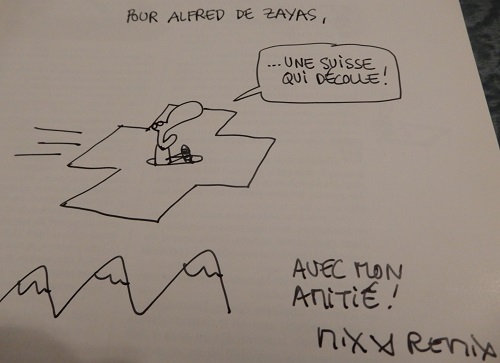
16-18 November -- 3 days of hiking in the sun
15 November -- writers in prison day -- PEN event with Daniel de Roulet
10 November -- lecture on self-deterination in Berlin
9 November -- lecture on Catalonia in The Hague
30 October - met Gilles-Emmanuel Jacquet at GSD. Joined again the oecumenical choir -- started practice for Christmas.
29 October -- non-stop rain, floods in Ticino.
23 October -- my three tortoises have started hibernation. First the oldest, then the younguest and now the middle one. It has been a long and warm summer and beginning of autumn. Hope they survive the winter, but they always do!
18-21 October --Carla and I hiked the Foggenhorn, Nessel, Rossalp, Simplon, but could not swim in the Rotelsee located near the pass at an elevation of 2,028 m, since it is not August anymore and the water temperature must have been around 10 degrees C, still, it was fun getting my feet wet
14 October -- Carla and I hiked up the Mont de Biere in the Jura, 1520 m.
21 Sept- to 8 October -- two splendid weeks in Noordwijk, Zoetemeer, Driehuis, Amsterdam, Rotterdam -- finally vacation!
10 September 2018 - my report on the mission to Venezuela and Ecuador was presented by my successor Livingstone Sewanyana.
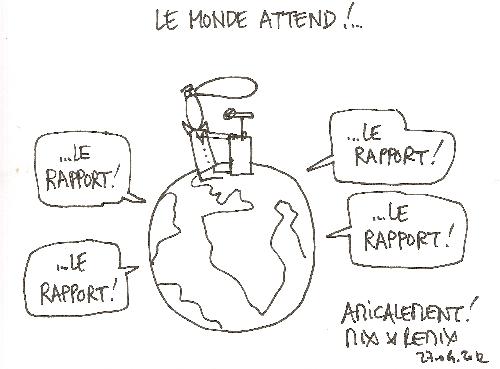
The late Philippe Becquelin, Mix & Remix, the cartoonist of the Hebdo weekly
magazine in Switzerland, made this design for me in less than a
minute.
3 - 21 September -- Carla and I cycled 1404 km through Switzerland, France, Germany and Holland to Noordwijk aan zee. Amazing trip -- not even a flat tire. But we did have some very strong headwinds -- 7 to 9 upon arrival at Noordwijk.
31 August -- Carla's last day at OHCHR after 27 years of professionalism. Her staff gave her a fitting farewell at the Parc de la Becassine in Versoix and both Carla and I jumped in lake Geneva to celebrate her early retirement.
27-28 August -- lecturing in Trieste
18 August -- Kofi Annan dies aged 80 -- in Bern
16 August -- Aretha Franklin dies aged 76. requiescat in pace. Remember listening to her records at Dane Hall, Harvard
14 August -- Autostrada bridge over Genoa collapses, killing dozens -- requiescant in pace.
13 August -- gave interview on missing persons in Cyprus and the Annan Plan.
12 August -- shooting stars over Geneva -- Carla, Martin and I watched the sky from 10 p.m. on and saw a wonderful display of shooting stars. I only saw 8 good ones -- but Martin thinks he saw 18! These falling stars are very quick and thus rather elusive!
10 August -- gave three interviews in English, two in Spanish on mi mission to Venezuela.
9 August -- stress test at my heart doctor -- top form
4 August -- village feast in Untermoos
3 August -- off to the chalet -- wonderful Wetterleuchten (sheet lightning) all night over the Wassenhorn and Monte Leone
2 August -- Carla invited 25 colleagues for a garden party -- so we BBQ notwithstanding the canicule
1 August -- Carla and I visited Stefan's grave -- today he would have been 22 years old. Then took the bikes and cycled around Lac des Rousses and Lac de Joux.
28 July -- Puigdemont is back to Brussels
27 July -- "blood" moon --
23 July -- gave an interview to the Real News on Julian Assange (https://therealnews.com/stories/julian-assanges-asylum-to-be-rescinded)
21-22 July -- cycled around the lake with Carla, spending the night in Velleneuve
20 July -- Jakob Möller visiting from Iceland. We chat about originality and hit on Aelius Donatos famous comment - perish those who articulated our ideas before us! Pereant qui ante nos nostra dixerunt
19 July - Madrid withdraws its international arrest warrents against Puigdemont and 5 others. Had I been the German judge in Schleswig-Holstein I would have immediately thrown the case out as frivolous and vexatious .-- worse, as an abuse of process and corruption of the rule of law
18 July -- met with Antony Hequet on his project Gyre
15 July -- swam in the Lusgersee in Belalp and walked to the Tyn munument
14 July - swam in the Schwarzsee in the Löetschental
10 July -- bought a big glass pane for the new bathroom -- cooked a rather good paella, which we ate in the garden, watching our happy family of red kites that have made the summit of our centennial fir tree their home
7 July -- good weather to fly a kite -- and splendid dining at Onder de Linde
5 July -- Carla's birthday. Celebrate with the Edelenbos family -- all of them ! -- at Tante Kee and take a wonderful boat trip on the Kaagse Plassen.
2 July -- cycle to Wassenaar and swim twice in the North Sea.
1 July -- Carla and I fly our two kites
29 June -- fly to Noordwijk aan Zee
25 June -- performance of Charlie Chaplin's 1928 movie - the Circus -- for which he wrote script and music -- at Victoria Hall
24 June -- do the culte at the chapelle des Creêts -- Letter of St. John, letter of St. James
23-25 June -- fête de la musique
9 June -- culte at the chapelle des Crêts -- first Corinthians, 14. Then a lovely fish bbq
8 June -- lunch with my successor as IE -- Livingstone Sewayana, Director of the Ugandan Foundation for Human Rights Initiative
30 May- 3 June -- celebrating my birthday at our place in Noordwijk aan zee. A pure delight.
26 May -- journée des caves ouvertes -- cycle over to the vineyards and by 6 bottles of gamay, 6 chardonnay, 6 pinos gris
20-27 May -- visit from Leo and Marianne Boer
14 May -- article in the Tribune de Genève about my mandate.
9-13 May -- traditional Ascension weekend hike with Daniel and Marie -- Soloturn, Konstanz, Reichenau island, Ittingen Kartause.
30 April -- Conférence de Presse at the Club Suisse de la Presse - 32 in attendance. Last day of my mandate.
28 April -- get my article against the Antifa in Germany -- published in Humanist Perspectives
https://www.humanistperspectives.org/issue204/zayas.html
29 April -- end of the Salon the livre -- meet Daniel de Roulet, Glorice Weinstein, Heike Fiedler, Bruno Mercier, Hoang Nguyen
27 April -- Koningsdag. Put out the Dutch flag. Elizabeth Evatt arrives from Sydney.
25 April -- Opening of the Salon du livre; PEN Committee meeting; finished my report on Venezuela/Ecuador mission
17 April -- memorial service for Claude at the St. George Cemetery, where our son Stefan is also buried
14 April -- illegal air attack on Syria by US/UK/France -- back to imperial days, legibus solutus
13 April -- interview to The Real News -- on skype -- warning against an illegal attack on Syria
10 April -- Claude Krul dies at the age of 87
4 April -- a delicious program in France Musique -- the letter of Baudelaire to Wagner -- cette musique est la mienne!
2 April -- visit from Jaap and Vera -- do a splendid risotto
1 April -- wonderful dinner at the apartment -- a local lamb
30 March -- Good Friday Service at the Oude Jeroen Kerk
29 March -- Lunch on the balcony. Holy Thursday mass in Noodwijk binnen -- buy vases at Kringloop
28 March -- flight to Amsterdam
24 March --- skiing in Crozet/Lelex, did the Aster piste 5 times, the competition red four times, a good 4 and a half hours
15 March -- my own side event at the Palais des Nations on 23 Principles of International Order
14 March -- the other two turtles wake up -- now all three are together
9 March -- side-event at the Palais des Nations on Venezuela
7 March -- one of the tree turtles wakes up
2-4 March -- skiing in Belalp, Bettmeralp, Riederalp
21 February -- Billy Graham passed away, aged 99.
15 February -- gave radio interview to the Breakfast Show, London
14 February -- St. Valentine's. Lovely class at GSD -- but coming down with what might be a flu, have 38 C temperature.
13 February -- gave televised interview on Venezuela
11 February -- voted in the Swiss national referendum -- to reject the "no-billag" initiative
10 February -- lovely culte at the chapelle des Crets, on the parable of the semeur
9 February -- panel at PN room XIV on inter-faith harmony; wonderful performance of Gounod's opera Faust
8 February -- delivery of 300 Ex Tempores -- very late, but start distribution immediately
5 February -- luncheon for Nadia's 78th birthday (17 Feb.)
3-4 February -- skiing in Belalp and Rothwald
1 February -- speak in the European Parliament on Catalonia's self-determination
31 January -- fly to Brussels, dinner at restaurant Tucan
27 January -- I do the culte at the Chapelle des Crêts Marc 7, 1-23
26 January 2018 -- 22ns Ex Tempore Salon
12 January -- submitted my final report to the Human Rights Council on "Principles of International Order"
10 January -- Pepin's birthday, call him in Pensacola
2-6 January -- skiing in Belalp
29 December -- travel to Piégon for the olive harvest.
28 December -- issue a press release on Venezuela.
24 December -- at 4 a.m. Caracas time Roberto Picon returned to his family, released from detention. Deo gratias.
23 December -- lovely skiing at Crozet/Lelex -- we did the red Astre piste five times!
15-17 December -- skiing at Riederalp and Bettmeralp
12 December -- Press conference at Palais des Nations in Geneva
10 December -- safely back in Geneva
6 December -- lunch with the first UN High Commissioner for Human Rights Jose Ayala Lasso at the restaurant Lo Nuestro in Quito
5- 9 December -- mission to Ecuador
26 November to 4 December -- mission to Venezuela
24 November -- concert/conference with Marie Neeser. 22 in the audience.
16-22 November -- escapade in Noordwijk
28 October -- hike in the Ganter valley near Simplon pass
27 October -- panel on the social responsibility of transnational corporations
22 October -- Raymonde Morizot died of a heart attack -- requiescat in pace
21 October -- the cherry on the cake -- rehearsal at Collins auditorium and concert at Fordham University Rose Hill with the ramblers
17 October -- beautiful presentation of my report to the GA in NY -- delegations applauded
8 October -- visit Raymonde Morizot in Evian-les-bains.
7 October -- wonderful cycling tour through the multi-coloured vineyards of Bourdigny, Choully, Peissy, Dardagny. The remaining two tortoises have gone into hibernation. Accordingly, I pulled in the turtle flag that always hangs from the first floor window.
6 October -- Dinner of farewell for the Ambassador of Peru. Give interviews to the BBC and Swiss radio on Catalonia.
5 October -- Ex Tempore event with Antony Hequet at the Salle de Cinema, room XIV PN
4 October - second press release on Catalonia goes out
2 October -- the first of our three tortoises has decided to hibernate. Wonder when the other two will get sleepy. The still look quite lively. Working on a new press release on Calatolina. It is a disgrace that it took Europe more than 24 hours to condemn the violence against the Catalans who were only exercising their right to vote -- and then in such bla-bla manner. When Brussels is trying to micromanage Hungary, Slovakia, Poland -- and violating the sovereignty of these countries -- how is it possible that it keeps silent in the light of the massive violation of civil and political rights in Catalonia?
1 October -- 26 years ago I cast eyes on my wife for the first time. It took a while for it to "click". Celebrated with a bottle of Pommery -- the champagne we had at our wedding.
30 September -- beautiful hike in the Gradeschtal near Mund.
29 September -- press conference at Palais des Nations. Twelve journalists came to listen to my presentation of my GA report on self-determination
26 September -- lovely class followed by the prayer meeting of the Christian Association of the United Nations.
25 September -- prestation de serment at the Bâtiment des forces motrices-- today I became a Swiss citizen
24 September -- my blog on Catalonia gets 10,000 hits and was retweeted all over
23 September -- Carla is very jet-lagged
21 September -- press release on international day of peace
16 September -- Antony Hequet's "Gyre" show in the Ford de l'Ecluse
15 September -- speak at the Place des Nations at an event of the Trieste movement. Go to Dr. Schopfer for a "quick" -- level 2.5.
14 September -- inter-active dialogue, the room and the gallery applaud after my concluding remarks, ending with Matthew V, 6.
13 September -- present my report to the Council, host a side-event with participation of Nicolas Levrat, Kirk Boyd, Arlon Stok and others, focusing on rule of law and self-determination
11 September 36th session of the HRCouncil begins
9 September Carla is off to Mongolia on mission.
3 September, back to Geneva after two wonderful weeks in Noordwijk ann Zee. We even got a sun-tan. In Holland!
5. August -- Concert in Ernen Musikdorf -- Schubert's Winterreise sung by the Dutch bariton Thomas Oliemans
1 August -- Stefan would have been 21 years old. RIP
30 July -- drove in the convertible up to the Nufenen Pass, then climbed to the highest point (400 more meters) to enjoy a spectacular view of the Berner Alps and the Ticino mountains.
21-22 July -- Carla and I hiked from Belalp to the Oberaletschhütte -- in 6 hours -- spent the night in the refuge and returned on the Saturday morning. Tremendous sights. I wrote on their guest-book
Beglückt, begeistert und beseelt durch diese reine Bergwelt danken wir Euch für die freundliche Aufnahme, gutes Essen, bequeme Betten, intelligente Gespräche mit Wanderern aus Russland, Deutschland, Schweiz — unvergessliche Stunden. Meine holländische Frau Carla Edelenbos und ich, Kubaner aus La Habana, genossen die belebende Atmosphäre der Hütte, die Aussicht, die Ruhe, den Himmel über uns. So schrieb Hesse
„Und die Seele unbewacht,
will in freien Flügen schweben,
um im Zauberkreis der Nacht
Tief und tausendfach zu leben“.
Ähnlich von Eichendorf
„Und meine Seele spannte
weit ihre Flügel aus.
Flog durch die stillen Lande,
Als flöge sie nach Haus“.
Befreiend ist diese gewaltige Natur, die uns gnädig empfängt. Berge haben was göttliches. Ararat, Sinai, Karmel, — auch die Seligpreisungen wurden auf dem Berg Tabgha ausgesprochen: Selig sind die Barmherzigen; denn sie werden Barmherzigkeit erlangen; Selig sind, die reinen Herzens sind; denn sie werden Gott schauen; Selig sind die Friedfertigen; denn sie werden Gottes Kinder heißen. Ja, wir sind beglückt!
15-16 July -- cycled through the Goms valley, swam in the Geschiner Lake near Ulrichen.
7-9 July -- cycled from the chalet to Geneva - 240 km. Friday from Moos to Saillon, Saturday to Rivaz just after Vevey, and Sunday to Grand Saconnex, getting drenched in the downpour between Rolle and Gland. By the time we were in Nyon, weather was beautiful again.
5 July -- celebrated Carla's birthday at home with a bottle of pink Ruinart.
25 June -- cycle around Lac de Joux. See the first two glowworms in the garden.
24 June -- culte at the Chapel des Crêts focusing on the message of John the Baptist.
23 June -- Bellini's Norma at the Opéra des Nations. Lovely music, silly production. closed my eyes.
21 June -- summer solstice. went for a swim with Carla at the UN beach, then ate in the garden and watched at 9:45 p.m. how some 15 bats devoured mosquitos over our heads. What a show!
18. June -- hiking on the Belalp
17. June -- our wonderfully successful PEN Club poetry reading at the Casino of Rolle
16 June -- Ernesto Lodoño published an article in the NYT in which he cites me.
6. June -- begin of the 35th session of the HR Council -- I am on ten side-events, either moderating or participatring as panelist
2. June -- helicopter flight over the Aletsch glacier
1. June -- beautiful day -- and night -- at Hotel Le Mirador on Mont Pellerin
31 May -- celebrated my birthday with 5 bottles of Pommery -- and lots of friends, including Nadia, Eva, Ruli from my Russian class, as well as Bruna Molina, Rosita de Cabrera, Paul Bailey, Martin und Oldrich Andrysek, etc.
23 May -- One of my role models and heroes -- Sir Roger Moore -- Ivanhoe, died aged 89 at Crans Montana.
10 May - go to Sandro Bertolini, my new tax advisor
4-6 May - chalet, drive the convertible
1 May - panel with the Foreign Minister of Ecuador, Guillaume Long
27-30 April. Salon du livre de Genève, Palexpo. Met
with Jean Ziegler
20-26 April. Spring meetings at the World Bank and
IMF.
8-18 April -- Cycling through Holland
1 April -- one last time -- skiing in Belalp, especially
on the magnificent black pistes 2, 3, 7 and 928 March -- meeting with Spanish Ambassador at the
Spanish mission in Geneva to discuss issues related to self-determination
generally and in Catalonia in particular
9 March -- panel on the
right to life. Appropriate moment for the turtle to wake up.
7 March -- two panels on self-determination.
3 March
- 3 panels -- women and migration, Guantanamo, Bretton Woods Institutions
and labour law (with Juan Pablo)
1 March -- Memento homo, quia pulvis
es et in pulverem reverteris. Went to Mass at
St. Hippolyte and got my ashes.
28
Feb. panel on Sri Lanka at Club Suisse de la Presse
26 Feb. glorious skiing at Les Contamines
25 Feb. General Assembly of PEN Suisse romand in
Lausanne. After 7 years as President I laid down my mandate and
we elected Bruno Mercier. We have 12 new members. Lunch at the
restaurant Lacustre on the Embarcadère.
22
Feb. lecture on self-determination at GSD and my student Elizabeth
Adams does quite an entertaining presentation on Trump's migration
decree and the Geneva Refugee Convention
20
Feb. first-rate lecture by Carla to judges and lawyers in Oslo
19 Feb. visit the National Museum -- lots of Kroghs,
Munchs, even Avercamps!
18 Feb. "Carmen" at the iconic Oslo
Opera House, built by the great Norwegian architecht Tarald Lundevall
16 Feb.
the Catalan press published a leak of my letter to the Spanish
Government on the issue of self-determination. Indeed, we are living
in a world of "leaks" -- but notwithstanding, the issue deserves
serene discussion. The realization
of the right of self-determination is indeed an effective conflict-prevention
strategy. Best for human rights is to sit down, talk to each other,
listen, negotiate.
15 Feb. draft a media statement for World Day of
Social Justice
14 Feb. wonderful truffe dinner at the Café de Certoux
for St. Valentines
lecture to students of the university of London at PN XI
11 Feb. -- glorious skiing in Crozet/Lelex - especially
on the pistes Rhodos and Astre
10. February -- visit Ilka Bailey Wiebeke at the
Résidence. Join Carla for Brahms' Deutsches
Requiem at the Opera
des Nations -- a Ballet. I closed my eyes most of the time. The
music says it all and the movements of the dancers do not elucidate
it. Better dance to a Mahler adagio.
6. February -- Olda comes for
a sauna and dinner
5.
February -- excellent exhibit Monet-Munch-Hodler at the Fondation
Giannada in Martigny
4. February -. bubble at the
Brigerbad spa
3. February
-- fly to Zurich and with the train on to the chalet
2 February -- lecture at the law faculty of the university
of Sevilla
1 February -- Trump nominates Neil Gorsuch to the
Supreme Court. Good choice.
29
January -- Oldrich, Lenka, Martin and Kat arrive at Moos to spend
a few days in the chalet. We return to Geneva by train.
28 January -- ski in Belalp 5 1/2 hours
27 January
ski in Grächen 5 1/2 hours
26 January -- Sir Nigel Rodley dies of cancer
22 January -- skate in the Grand Saconnex skating
rink
21 January -- do the culte at the Chapelle de Crets
-- Matthew 20 -- embellished by Matthew 5 and 25
20 January -- 21st annual Ex Tempore salon -- receive
the 27th volume of ET and start the mailing . There were 54 literature-lovers
in the audience, 17 readers in English, French, Spanish, Norwegian
and Albanian. Particularly enjoyed Eric Carlson.
14 January -- marvelous skiing in Riederalp/Bettmeralp
8 January - visit the Buckingham Palace collection,
including Vermeer, at Mauritzshuis in The Hague.
5 January -- fly to Holland
1 January 2017 -- glorious weather, succulent food
at the Neesers
30-31 December -- Olive harvest in Piegon, Drome
Provençale
27 December -- bought 2 new trousers at Le Mouton
26
December -- randonée
in the French Jura around Grilly, cold and sunny.
25 December -- blue sky. Lovely stroll down to the
jardin botanique. Pintade dinner at home with fresh canberries.
24 December -- midnight service at the Chapelle
des Crêts
22 December -- lovely performance of La
Bohème at
the Opéra des Nations.
21 December -- published a "complementary opinion"
-- a kind of dissenting/concurring opinion to the joint statement
of the special rapporteurs of 9 December, which I did not sign.
20 December -- Mix et Remix, Philippe Becquelin
passed away at the young age of 58 -- again, cancer.
20 December -- Bejart Ballet in Lausanne with Hans-Jörg
and Lia
18 December -- glorious skiing at Belalp
17 December -- Oberwalliser Chorensemble sings Bach's
Weihnachtsoratorio at the Collegium-Kirche in Brig
6 December --
celebrated our 20th wedding anniversary with our witnesses -- Jakob
and Fiona
26 November -- woke up to the news that Fidel Castro
passed away last night at the age of 90. Vitam impendere vero (Juvenal).
A man of many ideas. He certainly goes down in history as a major
figure of the caliber of Mahatma Gandhi and Nelson Mandela.
"Человечество жаждет справедливости"
"Жизнь без идей не стоит ничего. Нет большего счастья, чем бороться за них"
"Воин может погибнуть, но не его идеи"
25 November -- General Assembly
of the United Nations Society of Writers, we have a new secretary
Amos Wama Taporaie
24 November -- panel and presentation of the book
"Never Again" -- hosted by ADF
15 November -- concert and conference at home --
on the history and meaning of religious music
14 Novemer -- opening of the forum
business and human rights, which turns out to be more a forum on
the business of human rights
28 October -- lunch with Blerim, discuss his dissertation
24-27
October -- inter-governmental working group on the drafting of
a legally binding instrument on business and human rights. I participated
in the Thursday morning panel.
22 October
-- back in Geneva
21 October -- press conference
and 3 interviews to UN radio
20 October -- present my report to the GA¨
17 October - flying to New York
14 October --successful
expert consultation on taxation
13 October -- but out a press release that got picked
up in many news services.
8 October -- versnisage of the new stained-glass
windows at the chapelle des crets
4 October -- emergency PEN Committee
meeting at Montbrillant
1
October -- I met Carla exactly 25 years ago. Celebrated with champagne
-- and gave her a lovely opal.
29 October -- off to the chalet
27
September -- the PEN Congress at Ourense postponed the resolution
on amending the charter. Ouff.
15 September -- the 3 Swiss PEN Centres sent an open
letter opposing the amendment of our charter.
14 September -- my panel on privatization of
justice and the rule of law. -- dinner with Kirk Boyd, Joshua Cooper
and Martin Andrysek at Café du Soleil.
13
September -- successful presentation of my report to the HR Council.
Some 35 STate delegations took the floor and welcomed the report
and its recommendations. But total silence from the EU, US, Canada,
Australia, Japan. The 16 ngo's that took the floor endorsed the
report.
2-12 September -- Noordwijk aan Zee
23
August -- Marc Bossuyt and his wife Katrine for a BBQ in the garden.
19-21 August -- Chalet -- convalescing
16 August -- release from the hospital
15 August --
Dr. Pascal Bucher does a hernia operation on me
13-14 August -- Chalet, hike up Saas Grund to
Saas Almagell
6-7 August -- Chalet, hike up the Foggenhorn
1 August - wonderful fireworks and feu de joie in
Grand Saconnex
17-31
July -- Iceland
3-4 July - meeting in Rome of
the Lelio Basso Foundation. I spoke on trade and international
criminal law.
6-10 June meeting
of rapporteurs at the Palais des Nations.
2-3 June -- conference in Barcelona, met Professor
Juan Hernandez, author of Contra la Lex Mercatoria, panel in the
Catalan Parliament
1 June -- meet Anthony Hequet and Serge Conessa
31 May -- swimming in the Lido Adriano
30 May -- magnificent mosaics at Ravenna -- meet
Elizabeth Evatt and Penelope Seidler
27 May -- meet the trade representativve at IPU
24 May -- Soirée musicale at home
5-8
May -- Ascension holiday with Carla, Daniel and Marie -- Laco di
Orta, Alpa Quaggione
4 May -- take Swiss history exam
28 April -- speak
at Foodwatch, Paris
19 April --
speak at the Council of Europe
27 February
-- glorious skiing in Crozet/Lelex.
26 February -- wine fair in Annemanne
21 February -- finally the opened the black pistes
at Belalp.
20 February -- heavy snow at Moos/Blatten
29
January -- what a delight to see my God-daughter Michelle in Brussels.
26-28 January -- strategy meeting in Brusels on negotiating
trade agreements.
24
January -- skiing in Crozet -- never seen so many people on the
pistes -- and so many beginners. The rescue squad was busy.
23 January -- culte at the Chapelle des Crêts.
St. Paul's conversion, the amazing stories of his travels and the
episode in Athens with the Aeropagus speech on the temple to the "unknown
God" (Ἄγνωστος Θεός).
22 January -- in all
80 people showed up for the 20th Ex tempore evening -- and 19 read
from their own works. The salon lasted from 19h to midnight and
among the guests were the Ambassador of Ecuador, Maria-Fernanda
Espinosa, the Russian interpreter who did the vimeo film Matrix,
and the New Zealand intern who slept in the park. The John Knox
Centre helped with the catering and the mood was tops.
10 January - my brother's 70th birthday -- Carla
and I ski at Belalp with avalanche danger 4 --write the 47th strophe
of my skiing poem, dedicated to Chione (daugher of Boreas), the
nymph of snow. Take pictures in the white-on-white landscape. Difficult
visibility, but somehow magic -- and did not fall.
9 January -- Achim and Andrea Kornmann come to the
chalet for a Pommery -
2 January - visit from Walter Rabus and Wieneke
1 January -- Nieujahrsduik -- visit from Astrid Delissen
and Cees van Beers
31 December -- dinner at Villa de Duinen in Noordwijk
aan Zee
28 December -- Lenka came by for lunch --
27 December
-- Lovely walk up on the hills of Grilly in France.
Carla prepared
one of my favourite desert -- peras borrachas.
26 December -- amazing weather -- 12 degrees, sunny
and blue skies. Lovely walk along the Vesoix river.
25 December -- guinea fowl for Xmas dinner
22 December -- farewell from Thibaut, my excellent
OHCHR assistant. I light a candle in the hope that his successor
might not disappoint me too much.
9 December
-- Abelaziz and Ruth make oral presentation
8 December -- representative of city of Geneva comes
to inspect the house as a "historical building"
7
Decenmber -- Press release on COP21
5 December --
Carla runs the Escalade -- 29 min. 21 seconds, improving last year's
performance by more than 3 min
4
December -- UNSW/SENU General Assembly -- the board is reelected
3 December -- PEN Committee, panel at the Club Suisse
de la Presse
22 November -- Lascaux exhibit at Palexpo
19 November
-- Ocaproce panel on women and the sustainable development goals
16-18 November -- Forum Business and Human Rights
at the UN -- I participate in one panel and speak in three others
from the floor.
14-15 November -- great walks around the chalet
9 November -- Russian luncheon at ICRC -- Eva
Manalac returns tomorrow to the Philippines -- until 17 May 2016
8 November
-- Pen Club Writers in Prison Day --
Egyptian novelist
Mansura Eseddin spoke in arabic with French translation about censorhsip
and self-censorship, stratagems how to publish and the many ways
of expressing dissent. Very lovely afternoon.
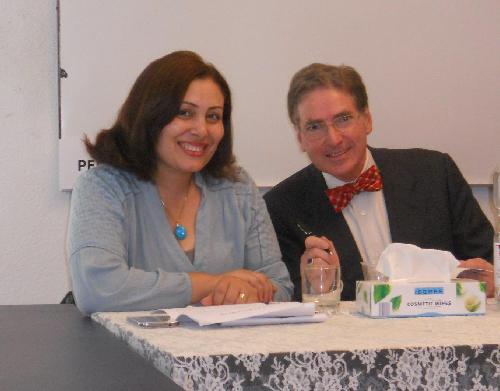
5 November -- Lecture at the University of Leuven,
200 students -- and good ones at that. Brown-bag luncheon, literary
discussion with Professor Jan Wouters, visit the old town and the
wonderful, wonderful library building
4 November -- teach, go to my tax advisor, PEN Committee
meeting at Montbrillant -- take plane to Brussels, dinner with
Dr. Marx at the zwarte schaap restaurant in the Leuven old town,
- he has phesant, I had hare. Both excellent.
31 October --
glorious walk up to the Belalp
30 October
-- train to chalet
29 October -- meet Rodolfo
at the Delegates lounge -- fly back to Geneva
28 October - Interviews in Spanish and French
to UN Radio
27 October -- lunch with Ray Messina, dinner with
Norman Finkelstein
26 October -- present report to GA, followed
by press conference
25 October -- Lunch with Leonor Sampaio, dinner with
Maritza Struyvenberg, Bob, Ian and Alessa
24 October -- fly to New
York, see Kirk Boyd
13 October
- consultation in room XXVII
27 Sept -- first bolets of the season -- to accompany
our first rable de lievre.
26 Sept - co-celebrate the culte at the Chapelle
des Crêts with Pastor Neeser
25 Sept - lecture on human rights at the law faculty
of the University of Leiden; farewell dinner for James Heenan at
Paolo David's home in Veyrier.
18 Sept. - two panels on Greece and austerity measures
14 Sept. - first Russian luncheon of the autumn season
-- without Christiane. How we miss her!
17 Sept. - oral presentation of my report to the
HR Council -- 25 states and 15 ngo's took the floor -- all positive,
but the silence from the US and EU was deafening --
12 Sept - hike 850 m up from the Simplon pass to
the Monte Leone refuge and 850 m down -- pretty cold and misty.
10 Sept. - jeune Genevois -- Carla and I cycle around
the Lac de Rousses and the Lac de Joux - jump in both lakes --
4-6 Sept. - glorious cycling from Naters to Raron,
including the serpentines climbing up to Moos
2 September - Ocaproce conference - deliver a talk
on gender equality and moderate a panel on the sustainable development
goals.
14-30 August -- a glorious cycling vacation in Holland.
Weather permitted us to to swim twice a day, play frisbee
and fly a kite. Food was also good, especially at Schudebeurs,
where we drank an excellent local Pinot Gris produced by the winery
De Kleine Schnorre. Gourmet food was served at Onder de Linde,
on the Voorstraat in Noodwijk-Binnen. Also got a lovely cocktail
table for the living room.
28 July -- my report to the GA is finished
-- now goes to formatting
26 July -- hiking in and around the Grimselpass,
swimming in the lake near Geschinen
25 July -- hiking in Grächen
24 July -- funeral of Christiane Kind in Bonneville,
France -- I speak for the Russian group and recite Pushkin's Ja
vas liubil, which Christiane and I used to sing together in the
Glinka romance -
21 July -- flamenco evening at the mountain home
of Judge Baltasar Garzon
20 July -- "ponencia magistral" at the
Universidad de Jaen. Receive the email with the awful news about
Christiane.
19 July -- Christiane Kind dies of a heart attack
-- and I do not learn about it.
9 July -- 3 hour lecture on international humanitarian
law -- at GSD
1 July -- gave interview to Le Temps on the Greek
crisis.
30 June --- a nice hedge hog walked by the fountain
in our garden, looked at us, kept on his way undisturbed.
29 June -- wrote a press release on the Greek crisis,
which Virginia Dandan co-signed.
27 June -- baptism of Ugo and Marina
Cedrango's third son Marco -- Carla is the Godmother. Lovely ceremony
and lots of kids.
22 June -- Gaza report published
20 June -- best man at the wedding of Patrick and
Olga Taran
15
June -- panel on Chevron v. Ecuador
8 June Geneva
-- HRC report almost finished.
5 June Venice
4 June Trieste
3 June Duino Castle overlooking the Adriatic. Here
Rainer Maria Rilke wrote the first two of this ten Elegies. I actually
reread the Elegies and wrote this little poem by way of spontaneous
reaction.
2 June Concordia
1 June Jesolo Lido
31 May cycling from Venice along the Adriatic toward
Trieste.
24 May - long hike with Carla in the Bois de Finges
between Leuk and Sierre. Lots of pretty butterflies, which inspired
me to write a little poem Passion Papillons
29
April - 3 Mai - Salon du Livre de Genève.
I lectured at the Armenian stand on "Reparations in International
Law". Lots
of visitors at the Stand of PEN Suisse romand -- including my friends
J. Alexis Koutchoumow and Professor Jean Ziegler.
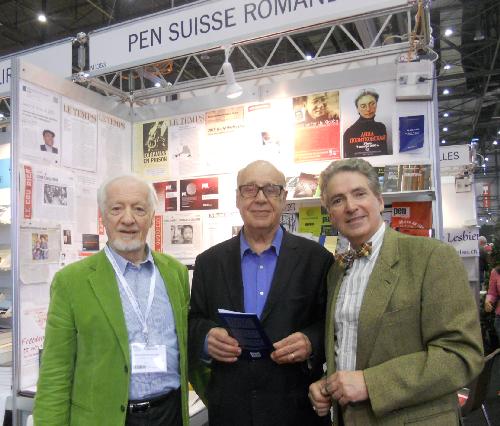
23 March -- UN side-event with Baltasar Garzon and
Julian Assange.
21 March -- General Assembly of PEN Suisse romand
in Lausanne. We elected 3 new members of the Committee -- Alix
Parodi, Heike Fiedler and Bruno Mercier.
20 March -- visit Professor
Yash Tanden in Oxford.
19 March -- conference on internatinal sanctions
regimes in London.
14 March -- glorious skiing in Saas Fee.
9. March
-- panels on women in armed conflict and on vulture funds.
8. March -- the yearly miracle reenacts itself:
our tortoise wakes up after 4 and a half months of hibernation
7. March
-- skiing in Crozet/lelex, probably last possibility on the Jura,
since it is too low. Next weekend back to Belalp.
6 March -- speak at Panel
on self-determination in room XXI.
5
March -- Human Rights Film Fesival -- Citizenfour -- and Ed Snowden
live on Skype from Moscow.
4 March -- Michael
Volle sings Schubert's Schwanengesang at
the Grand Theatre.
1 March -- it snows in Naters-Moos.
28 February --
glorious skiing in Belalp. Especially the tunnel piste. A black
that is so wide that it can be taken as a red.
20 February -- UN panel on Camps Ashraf and Liberty.
World Day of Social Justice. Put out a media
statement.
19
February -- lovely performace of Porgy and Bess at the Grand Theatre.
11-12 February -- conference at Carter Centre, Atlanta,
on democracy and elections. Private meeting with President Carte
or initiatives for peace and democracy
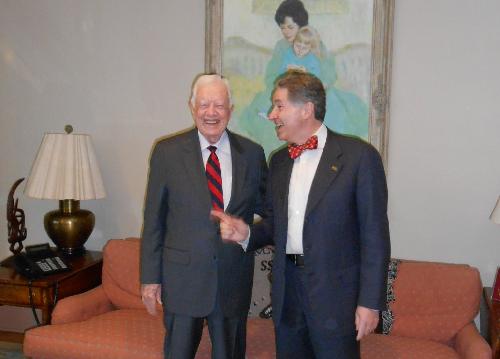
10 February -- conference
at Carter Centre on women's role in peacekeeping and violence against
women.
7-10 February -- visiting my brother and his wife
Susan in Pensacola, Florida
1
February -- no skiing -- snowing all day -- read history instead
31 January
-- glorious skiing in Belalp
30 January -- spoke twice at the consultation on
the right
to peace.
29 January -- Gluck's Opera Iphigène at
the Grand Theatre. Wonderful voices, orchestra, melodies -- ludicrous
mise-en-scène.
28 Janaury -- meeting of my PEN Committee -- très
convivial. AGO has been fixed for Saturday 21 March.
26 January -- again snow over Geneva. The garden
looks gorgeous.
25 January -- 5 hours of glorious skiing at the Col
de la Faucille, half an hour away!
23 January -- 19th Ex Tempore salon -- 60 participants.
http://www.preshevajone.com/presheva-jone-promotes-albanian-poetry-at-un-society-of-writers-event/
22 January -- lectured at Webster University
18 January -- 6 hours skiing in Riederalp/Bettmeralp
-- pure powder -- ane even saw 10 chamois!
5
January -- piked up 14 see stars from the shore -- now drying in
the cellar.
1 January 2015 -- took a dip in the North Sea at
Noordwijk.
30. December -- dinner at LaTour.
20 December -- my interview to Zeit Fragen came out
in English in Current
Concerns.
17
December - Opera at Grand Theatre
16 December -- meet Alix Parodi at Hameau St. Maurice
15 December -- medical -- blood pressure still low,
100 over 60.
14 December -- the english version of my interview
came out in Current
Concerns.
13 December -- conference at the Zentrum Paul Klee
in Bern -- UN and Parliaments, together with Ambassador Anda Filip.
10 December -- all day conference at Future of Human
Rights Forum. Criag Mokhiber was particularly effective.
8-9 December -- Vienna Conference on Humanitarian
Impact of Nuclear Weapons. Here my statement on the urgent need
of disarmament.
15 November -- got 10 liters of my slivovitz
1
November -- swim in Nordwijk on the North Sea -- the warmest 1st
November on record, 17 degrees air temperature, 15 degrees water
temperature and mild winds. Glorious fresh herring to eat!
31 October -- fly to Holland
29 October -- meeting
at US mission to the UN, visit Decolonization Committee, interview
to UN radio, fly back to Geneva.
28 October
-- press conference
27 October -- presented
my report to the GA
26 October -- cocktail party at Leonor Sampaio's.
25 October -- ILA panel on new human rights mechanisms
24
October -- ILA panel on geo-engineering
23 October -- fly to NY arrive at Millennium Hotel
in front of UN -- meet with indigenous.
20 October
-- finished the media statement and my presentation of the report
to the GA
18 October -- hike
from Simplonpass to Simplondorf with Carla, Marie and Daniel
17 October -- finished repairing the
Oratoire in Moos --
14 October -- spoke to the IPU 131th assembly
14 October -- Library event, 25 years UN writers.
Daniel de Roulet spoke.
9
October -- Erskine Lecture at the Hilton in London
3
October - the new High Commissioner at the meeting of Special procedures
29 Sept. opening to the meeting of Special
Procedures Mandate holders.
28 Sept -- almost a summer day. Cycled around the
Lac de Joux and swam twice in the lake.
27 Sept. -- Carla and I
swim again in Lake Geneva (one last time?) -- under amazingly mild
autumn temperatures -- air 21 degrees, water 18.
26 Sept. -
International Day for the Total Elimination of Nuclear Weapons.
-- Panel with Ambassador Filip, Director-General Michael Moller
in Room XIV of PN.
25 Sept. -- The Human Rights Council adopts a resolution
extending my mandate until 30 April 2018.
24
Sept. - Bryn Terfel, the Welsh bass-baritone gave a brilliant recital
at the Grand Theatre. Everything from Schumann to Schubert to Ibert
and the Welsh composers!
4 Sept - Panel with
Colin Archer, Pavel Podvig, Ambassador Filip -- excellent presentations
by everybody.
16 September
-- Panel with Women's
International League for Peace and Freedom, chaired by Madeleine
Rees.
15 September -- Thierry-Daniel
Coulon performed his dramatic monologue "H2O" in
our salon before an audience of PEN and UNSW members.
14 September -- stroll in the Lötschenthal up to
the Schwarzsee, where I had a lovely swim.
13 September -- 6 hour hike from Stalden/Gspon to
Saas Grund/Saas Balen. Spectacular views over the Michabel chain.
12 September -- 50 kilometer cycling tour through
the Goms from Oberwald to Geschinen (jumped in the lake) to Münster,
Niederwald, Ernen, Binn, Lax and back to Brig.
10 September -- dinner with Anne Marie Demmer
and the Andryseks at Prevesin.
10 September -- Presented my third report
to the Human Rights Council. All States and ngo's that took the
floor in the inter-active dialogue were supportive. Alas, some
important States did not comment. The intervention of the International
Peace Bureau was impressive.
4-9 September -- Six glorious days at the
beach in Noordwijk. Swam every day in the North Sea -- which was
19 or 20 degrees. Even got a suntan. In Holland!
3 September -- courses started
at GSD. I met my new history students.
2-3 September -- moderated the OCAPROCE Forum on
women's rights.
31
August -- Lovely hike next to the Suones of Tennhoh in Oberwallis,
up to the hanging bridge.
30 August -- Schäferwochenende
at Belalp -- some 650 sheep made their way up from the Aletschji
valley, where they had spent the summer grazing, up to the Belalp.
A very bon enfant folks feast typical of the Oberwallis.
22 August -- merry performance of Franz Lehar's
Graf von Luxembourg
20 August -- a glorious production of Rosenkavalier
at the Salzburger Festspiele.
18 August -- visited the Archeological Museum in
Bozen to see "Ötzi" the man from the ice.
14 August -- 25 years ago Sergio Chaves, Leonor Sampaio
and I founded the United Nations Society of Writers. To celebrate
current UNSW writers met at the Press Bar. Here we are 15 members
of the United Nations Society of Writers marking the day of the
launching -- I read excerpts of poems and essays by Leonor and
Sergio.
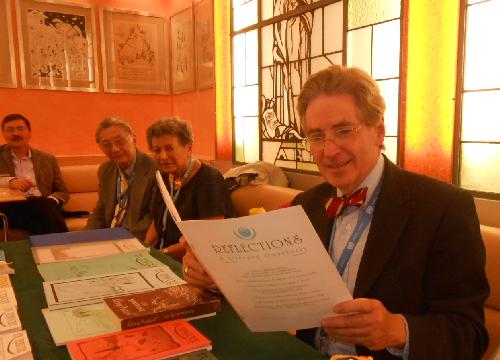
14 August -- spoke at the Advisory Committe on PEN
International and the Bled Manifesto on Peace.
13 August -- spoke on the panel on Ashraf: The
Right to Peace and the Responsibility to Protect.
12
August -- Robin Williams has left us at age 63. I will never forget Dead
Poets Society.
11 August -- my report to the Human Rights Council
is out.
9 August -- wonderful concert in the Church of St.
George in Ernen, Valais. Works by Felix Mendelssohn-Bartholdi and
his sister Fanny, Bach chorals and a fascinating piano quintet
by Cesar Frank.
6 August -- next semester I'll be teaching world
history. Here the syllabus.
1-3 August -- Carla and I cycle 240 km from the chalet
back to Geneva. Some lovely swims in various lakes.
27 July -- lovely walk from Rothwald
to Rosswald in the Valais, 7 hours of gorgeous views
25 July -- submitted my
report to the GA
4 - 13 July
- glorious holidays in Noordwijk aan Zee, swimming, picking up
shells on the shore, cycling through the dunes, walking, walking,
walking, visiting churches and museums, reading fiction, not just
official reports and analyses.
3 July - spoke only once at the working group --
did 16 pots of mirabel jam.
2 July - spoke eighteen times in the working group
1 July - spoke three times in the working group
30
June -- delivered a statement at the open-ended inter-governmental
working group on the right to peace
30 June -- met Matej Jancosek's father -- learned
that he was the valedictorian yesterday
25
June -- submitted report to Human Rights Council.
24 June -- lovely performance of Alfredo Catalani's
opera "La Wally" at the Grand Theatre.
20-21 June -- drove to Torino to pick up Carla after
the cycling trip with Elizabeth. Lovely "design hotel" Boston,
and superlative food.
20 June - spoke at a UN panel on Iraq and a panel
on women empowerment. Still jet-lagged!
7-14
June -- Indigenous Conference in Anchorage Alaska, followed by
visit of villages in the Kenai Peninsula.
3 June -- lecture at Webster University.
29 May - 1 June -- hiking holiday in the Bourgogne,
feeling like a "pilgrim" and arriving all tired and worn at the
wonderful Basilica of Vezelay. Bought some Vonay, Beaune and Pommard
reds, then at la Charité sur Loire took my ritual birthday swim
in the Loire river and bought some wonderful Pouilly Fumé and Sancerre
whites.
20-25 May -- a very lyrical Ring des Nibelungen at
the Grand Theatre with a splendid cast and an understandable mise
en scene by Dieter Dorn.
23 May -- workshop of unilateral
coercive measures.
April
23 -- PEN Committee meeting at Montbrillant.
April
20 -- Easter Sunday at St. Mauritius in Naters, followed by the
opening of the Ort der Begegnung.
April 15-18 April
-- International Association of Democratic Lawyers 18th world congress
at the Vrijeuniversiteit in Brussels. I spoke in three panels and
in the plenary.
April 14
- Global Day of Action on Military Spending. Panel with the Chair
of the UN Conference on Disarmament, Michael Möller. Issued
a media statement.
April 2-3 -- conference hosted by Democracy International
at the UN in Vienna. Also met with Andreas Bummel, the secretary-general
of the campaign for a UN Parliamentary Assembly.
Friday 21 March -- meeting with the secretary general
of the International Peace Bureau, Colin Archer.
Friday 14 March -- Panel at the
UN in room XXI of PN on camps
Ashraf and Liberty, together with Jean Ziegler, Bernard Kuchner
and Linda Chavez. Film and celebration in honour of Theo van Boven,
Director of the UN Division on Human Rights 1977-1982, who did
so much for Latin America and who hired me into the UN in 1980.
I had a lovely chat with him and gave him my interview on the CELAC
declaration of Latin America as zone of peace.
Thursday 13 March -- visit Bent Sörensen and his
wife Inge, both great pioneers in the fight against torture.
Tuesday-
Wednesday 11-12 March -- conference at the Danish Institute for
Human Rights
Monday 10 March -- panel on self-determination.
PEN Committee meetring. Fly to Copenhagen.
Saturday 8 March -- International Women's Day. Celebrate
it with Carla on the slopes of Crozet/Lelex. The Astres piste is
as fast and challenging as ever.
Friday 7 March -- Nabucco at
the Grand Theatre. Lovely music, miserable production.
the second tortoise woke up. Washed
her, gave her water and put her under the light. She seems happy
as Larry.
Thursday 6 March -- UN Panel on Women's rights in
armed conflict, and the on-going tragedy of the Central African
Republic.
Wednesday
5 March -- Ash Wednesday. Memento homo, quia pulvis es et in pulverem
reverteris.
Wednesday 5 March -- the first of our two turtles
has woken up from hibernation. What a miracle! Nearly 5 months
without eating or drinking anything at all -- and there she is,
happy and again hungry!
Thursday 13 February -- 69 years ago the Anglo-Americans
carried out the infamous terror attack over the city of Dresden,
a major war crime for which there was, as so
often, total impunity for the perpetrators -- not even the recognition
of the enormity of the event, routinely banalised
by journalists and politicians. It is even more pathetic how political
historians are intent to reduce the number of civilian victims
(after all, they were "the enemy"), proving how little
these apologists understand of human dignity -- and of history.
More figure skating at Sochi. the 19 year old Japanese
Yuzuru Hanyu was best with 101 points. I liked the Canadian Patrick
Chan, the German Peter Liebers and the American Jeremy Abbott,
who took a bad fall, which looked like it hurt him, but showed
remarkable resilience and stoicism in continuing the performance.
Later, after a conquille St. Jacques dinner, we had lots of excitement
in the house with a bat flying about -- it took me more than half
an hour to persuade him to fly away -- had to open all windows
and doors. I fear that he may have hibernated somewhere in the
house -- and that there may be more where he came from!
Wednesday
12 February -- glorious figure skating at Sochi. Russia's Tatiana
Volosozhar and Maxim Trankov took gold, Russia's Ksenia Stolbova
and Fedor Klimov took silver and Germany's Aliona Savchenko and
Robin Szolkowy bronze after the Figure Skating Pairs Free Skating
Program.
Sunday
9 February -- citius,
altius, fortius. Wow
and again wow! The performances at the Sochi Olympics are truly
breathtaking. Is there anything as aesthetic as figure skating?
The Russian couple Elena Ilinykn and Nikita Katsalopov took the
gold, the Americans the silver and th Canadians the bronze. But
all three were divine. So too the Italians and the Japanese who
came in 4th and 5th. The girl boarders did absolutely amazing things,
and the American truly deserved the gold. There is so much talent
out there in the world -- and we are the privileged ones who
can admire it. Awsome!
Saturday 8 February -- meeting of the coordinating
committee of the 3 PEN Swiss Centres in Luzern. It's the turn for
the Presidency of the Centre Suisse romand -- so it's my baby.
(Photo by the President of the Deutschschweizer PEN Zentrum, Michael
Guggenheimer, from left to right Ari Blum, Franca Tiberto, Enzio
Bertola, me and Zeki Ergas)
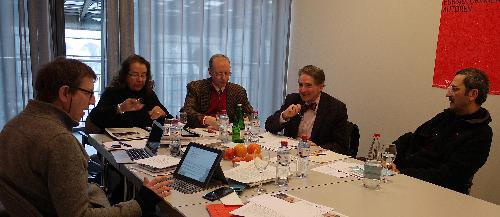
Friday 7 January -- Opening of the Sochi winter Olympics.
Absolutely otlichno! The ethereal soprano Anna Netrebko
performed the Olympic anthem-- for me that was the best moment
of the evening!
Lectured at GSD in the afternoon: got nice new
students in my masters class on human rights monitoring mechanisms.
Thursday 30 January -- the 33 countries of the Community
of Latin American and Caribbean States concluded its summit in
Havana yesterday and issued a Declaration proclaiming Latin America
and the Caribbean a Zone of Peace. This is a wonderful example
for the world and it will bear fruit.
Wednesday 29 January --It is snowing. I do the induction
for the new students at the Geneva School of Diplomacy.
Tuesday 28 January --
UN panel on freedom of expression in Cambodia, hosted by Article
19 and PEN International. I spoke on the five Special Procedures
mandates that should be engaged to address the multiple violations.
This was followed by Cambodia's UPR before the Human Rights Council.
On Friday 24 January 2014 the United Nations Society
of Writers held its 18th annual salon hosting 61 literature enthusiasts
and 17 readers from the UN, UNCTAD, UNHCR, OHCHR, ILO, PEN Club
and the Société Vaudoise des Ecrivains. Participants
declamed poetry and epigrams in Arabic, English, French, German,
Latin, Russian, Spanish, and Vietnamese. Aline Dedeyan performed
her funny sketch "tax evasion". We celebrated the 100th anniversary
of the birth of the American poet William Stafford, and the 150th
anniversary of the birth of Richard Strauss, who was not only a
superlative composer, conductor and orchestrator but a widely read
intellectual with high literary sensitivity and judgment, who used
the best writers of the day as his librettists, including Hugo
von Hofmannsthal and Stefan Zweig, and put to music poems by Hermann
Hesse and Joseph von Eichendorff. Several of our amateur
poets paid tribute to Nelson Mandela and the multiple links between joie
de vivre, diversity, pluralism, freedom of opinion, literature,
culture, mutual respect and peace.
18 January -- Das Hexenrennen at Belalp.
Lovely day of skiing and photographing "witches" in
all sorts of costumes sweeping down the slopes. Our favourite
black piste was closed, but the blacks 2, 3 and 14 were
open and garanteed a glorious adrenalin rush.
23
December -- Ex
Tempore XXIV is out.
22 December -- oecumenical concert at St. Hipolyte
Church followed by vin chaud
19 December -- Lecture at the Fachhochschule in Zürich
-- some 200 students and targeted questions
10 December
-- moderated a panel on new human rights structures at the Future
of Human Rights Forum
5 December -- spoke
at the celebration 20 Years OHCHR
4
December -- spoke at the presentation of the new book on the Right
to Development
3 December -- UN Conference on Business and Human
Rights
2 December -- Press Release on Ashraf
7 November-
1 December: Vacationing in Australia
5
November -- at the General Assembly of the United Nations Society
of Writers we elected Marko Stanovic as our new President.
31 October -- meeting with Ambassadors of Palestine
and Sri Lanka
30
October - dinner with Jeanne Mirer, president of the International
Association of Democratic Lawyers
29 October
-- panel at the International Peace Institute, reception by Ambassador
John Hirsch, interview for IPI
28 October - presentation of my report to GA and
press
conference, reception at Amnesty International. Good communiqué
de presse by the UN office.
27 October -- lunch with Professor Finkelstein, dinnner
with Maritza Struyvenberg and family
26 October -- memorial service for Kevin Carlson
in Canaan, Connecticut
25 October -- interview on Amherst Radio
24 October -- UN Day, lecture at Harvard Law School,
hour interview with Professor Noam Chomsky at MIT
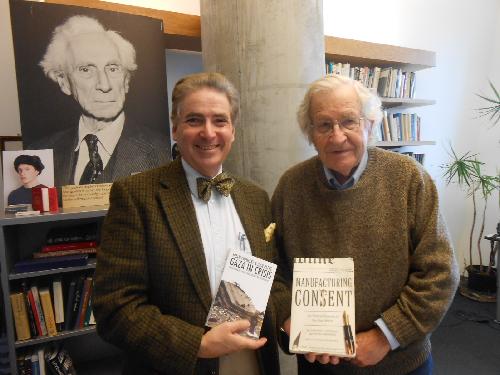
16-17
October -- Brussels Conference at the European Parliament, moderated
by Jo Leinen MEP (SPD)
8 October -- concertante
performance at Victoria Hall of Ernest Reyer's opera Sigurd,
magnificently sung. What a delight to hear something I did not
even know existed! Must buy the cd!
7 October -- my German interview to Zeit-Fragen has been translated into English and published in Current
Concerns.
6 October -- lovely swim in the North Sea at Noordwijk.
Water temperature around 15 centigrade.
27
September -- delivered a lecture in French before some 150 students
of the University of Geneva: La promotion d'un ordre international
democratique et equitable: mode d'emploi.
24-25
September Conference on the Right of Public Participation at the
Danish Institute for Human Rights in Copenhagen. Glorious autumn
weather.
17 September panel in room XXIV hosted by the mission
of Ecuador with the participation of the Wikileaks spokesperson
Kristinn Hrafnsson and Julian Assange himself from London on inter-active
video conference. The room was packed to capacity -- in any event
well over 200 in the audience.
13 September, met with the mothers of two murdered
residents of Camp Ashraf in Iraq. Gave an interview to UN radio
in NY.
12 September, spoke at a panel on women and children
in armed conflict.
11 September, continuation of inter-active
dialogue on my report and concluding
comments. Spoke at a panel
on self-determination. Issued a press release.
10 September, delivered an opening
statement to
present my report
to the Council and listened to State reponses and those of 7 ngo's
during the inter-active dialogue.
9
September -- moderated a UN panel on Human Rights and armed conflict
-- focusing on Syria.
6 September -- watched the Schäferfest in
the village of Mund and in the evening went to a wonderful performance
of Georg Friedrich Händel's opera Alcina in the courtyard of the
Stockalper Schloss in Brig.
5 September -- Carla and I cycled from Oberwald to
Niederwald and swam twice in a secluded mountain lake.
18 August -- exactly ten years ago my boss Sergio
Vieira de Mello was killed in the terrorist blast that destroyed
the OHCHR office in Baghdad. I had spoken with him on a Saturday
afternoon at the Palais Wilson a few weeks before that. Requiescat
in pace.
6 August -- went to the cemetery. Our son Stefan
would have been 17 years old. God giveth, God taketh away. We count
our blessings and accept destiny as it comes, taking comfort in
Reinhold Niebuhr's prayer: God,
give us grace to accept with serenity the things that cannot be
changed, courage to change the things which should be changed,
and the wisdom to distinguish the one from the other.
1 August -- glorious cycling
around Lac des Rousses and Lac de Joux -- 65 km in 6 hours including
three swims.
28 July
- wish I had been in Copacabana for Pope Francis' Mass on World
Youth Day!
25 July -- lecture by Noam Chomsky at the University
of Geneva
18
July -- Nelson Mandela's 95th birthday! Prooooooost!
6
July -- big family get-together in Noordwijk. hartstikke
gezellig.
5
July -- Carla's birthday, suitably celebrated at the Le Tour restaurant
of the ter Duin Hotel in Noordwijk.
3 July
-- finished the first draft of my report to the General Assembly.
Coup d'état
in Egypt. Let's pray for an end to the violence.
2 July -- international law imbroglio with Ed Snowden,
Evo Morales, Austria, France, etc. A whistleblower may be a hero
and serve democracy by demanding accountability and transparency
from governments -- but it is tough going.
30 June -- finally a sunny day. We did the 4-hour
hike up and down the Massaschlucht, crossing the ravine down by
Wassen and then taking the steep climb to Hegdorn at the end..
29 June -- it was cold in
the chalet and we lit the fireplace, drank vin
chaud and watched the rain outside.
27-28
June -- Vienna plus 20 celebrations. I participated in the workshop
on the post 2015 development agenda, Carla in the workshop on enforcement
mechanisms and remedies for victims.
24-28 June
- meeting of independent experts and special rapporteurs in Vienna.
27 June - Bejart Ballet in Lausanne to music of Gutav
Mahler.
20 June my interview with
the Future of Human Rights Forum finally came out in internet.
19 June - glorious singing of Dvorak's Rusalka at
the Grand Theatre -- Camilla Nylund was spectacular as Rusalka
and Ladislav Elgr as the Prince. Pity that the mise-en-scene was
banal to bad.
14 June - UN Panel on faith and human rights
7 June - UN panel on Camps Ashraf and Liberty
6 June
- consultation of the independent expert on initiatives for a world
court of human rights, held in room VIII of the old Palais de Nations,
the same room used by Eleanor Roosevelt when drafting the Universal
Declaration of Human Rights..
opt.jpg)
5 June -- side-event on the right to peace.
4 June -- UN panel on women empowerment
31 May- 2 June Venice biennale.
30 May - consultation on international solidarity
with Rapporteur Virginia Dandan, followed by panel on Camp Ashraf
22 May - Our High Commissioner Navy Pillay convened
some of the old hands to a lovely get-together at the Palais Wilson
-- some of us who participated at the 1993 Vienna World Conference
on Human Rights in those happier days of optimism and effervescence
-- what a privilege that was! And what camaraderie! (I am second
from the right)
19 May -- Pentecost Sunday. Veni creator spiritus!
18
May - Richard Wagner's 200th birthday. Played the wonderful CD
by Loorin Maazel "Tannhäuser
without words" and
then a Bayreuth compilation.
17
May -- a pure joy! Dustin Hoffman's directing the "Quartet" --
a truly feel-good movie with Maggie Smith and Tom Courtenay. You
come out of the cinema singing Rigoletto!
16 May -- very successful consultation on my mandate,
with top participants including Professor Vera Gowlland, Professor
Daniel Thürer, Prof. Harro von Senger -- and the Director
of the Campaign for a United Nations Parliamentary Assembly, Andreas
Bummel.
1 May -- Opening of the Geneva book fair. A world of new
and wonderful books. I gave a lecture on Rilke.
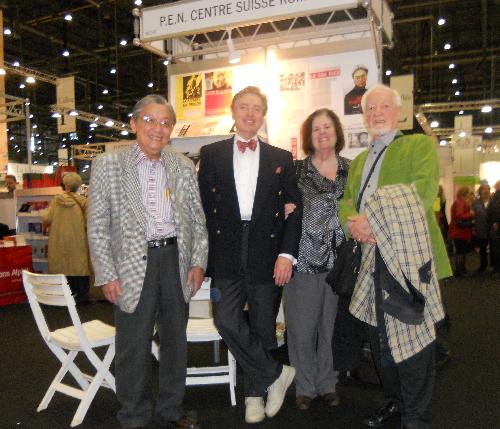
Tuesday 30 April - Oranje Boven! Lang leve Koning
Willem Alexander! Vandag is de Troonwisseling! Lang leve de oude
Koningin Beatrix. Welkom Koningin Maxima! Wij trinken natuurlijk
Oranjebitter. Habemus regem.
Monday 29 April - tenor Rolando Villazón sings down Victoria Hall
with an all Verdi program. Lots of bravado without unnecessary
pathos.
Friday 26 April -- gave an interview on Guantanamo
to Prensa
Latina -- in Spanish.
Wednesday 10 April. The April UN Special came out
and published an article on Ex
Tempore.
Sunday 31 March -- Urbi
et Orbi --
Peace and reconciliation, respect for God's Creation, reject greed
and short-term advantage.
Saturday 23 March -- a year ago I was
appointed Independent Expert by the Human Rights Council -- it
has been an exciting year and I have met splendid people. Meanwhile
my second set of reports for the HRC and General Assembly are in
the pipeline. To celebrate: Carla and I hit the slopes again, this
time in the Monts Jura chain. A remarkably nice day of skiing,
even if the sky was grey. In the evening we had service at the
Chapelle des Crêts and I did the meditation.
Friday 22 March -- to mark World Water Day eight
UN rapporteurs, including myself, issued a press
release stressing
that water is a human right, not a commodity.
Thursday 21 March
- wonderful performance of Das Rheingold in a mise-en-scene of
Dieter Dorn with an amazing Alberich, John Lundgren, and a very
funny Loge, Corby Welch.
Wednesday 20
March -- United Nations International Day of Happiness. The UN
Library and Ex
Tempore did a successful poetry reading to conjure up the
good spirits -- we were seven readers before an audience of 32,
followed by a Haiku workshop.
 . .
Tuesday 19 March -- feast of St. Joseph -- and the
inaugural Mass of Pope Franciscus in Rome. Very touching homily
-- made me think of the Sermon on the Mount, simple, straight-forward,
comforting.
Monday 18 March -- snow galore
over Geneva. Winter does not want to go.
Sunday 17 March -- quiet day listening to this young
Peruvian tenor Juan Diego Flórez -- what a wonderful voice for
Bellini!
Saturday 16 March -- the General Assembly of PEN
International Centre Suisse romand (the Pen
Club of the french-speaking Swiss cantons) meeting in Lausanne
elected me as its President. This is my second tour of duty. Time
to draw inspiration from Robert Frost, William Wordsworth, Hermann
Hesse, Rainer Maria Rilke, Victor Hugo, Joachim du Bellay, Jose
de Espronceda, Antonio Machado, Gabriel García Marquez (to
name some of my favourites), knowing that literature is definitely
more fun and more invigorating than politics.
Friday 15 March - UN panel on Iraq and
reparation to victims of gross
violations of human rights.
Thursday
14 March - side-event on Iraq, I spoke on the Security Council
and its mandate under article 24 of the UN Charter. Exchanged views
with Hans-Christoph Graf von Sponeck and Professor Jean Ziegler.
Wednesday 13 March - Habemus
Papam! Viva Franciscus! Sursum corda! As Archbishop of Buenos
Aires he once said with regard to the political leaders of his
country: “Power is born of confidence, not with manipulation,
intimidation or with arrogance". I would add, legitimacy depends
on truth, sincerity and consent of the governed. People matter!
Tuesday 12 March - meeting with working group on
enforced disappearances; meeting with Kofi Annan Foundation.
Monday 11 March - spoke in two side-events at the
Council - on the human right to peace, and on the world constitutional
court.
Sunday 10 March -- the two tortoises woke up (probably
already while I was in the UK) after four and a half months of
hibernation -- looking around, curious as ever. Washed them, gave
them water and dandelion leaves. They seem happy.
Haec dies quam fecit Dominus:
exultemus et laetemur in ea. They are still somewhat groggy. So, in
order to get them going, I am trying Richard Strauss' Also sprach Zarathustra on
them -- surely better than Eine Kleine Nachtmusik.
Saturday 9 March - lecture on my mandate at the University
of Nottingham.
Friday 8 March - International Women's Day -- introduced
the Danish film "Enemies of Happiness" about women in Afghanistan.
Thursday 7 March - lecture on freedom of expression
at Middlesex University.
Wednesday 6 March -- meeting with the International
Commission of Jurists on possibilities of cooperation on the World
Court project and IBOR's international bill of rights.
Tuesday
5 March -- panel on the death penalty.
Monday
4 March -- panel on self-determination.
Thursday
28 February -- last day of the pontificate of Benedict XVI. We
will miss him. Sursum
corda! Ἄνω σχῶμεν τὰς καρδίας.
From the balcony of Castel Gandolfo to the crowds gathered in the
piazza below, his final greeting to the faithful was humble and
profoundly human, in that benevolent style we
have learned to appreciate over the past eight years: "Da
oggi sono solo un pellegrino".
Thursday 28 February -- spoke at two United Nations
panels, one on violence against women, the other on the crisis
affecting the Mujahedin refugees in Camps
Ashraf and Liberty. The
other participants in the high-level panel were Mme Maryam Radjavi, Struan
Stevenson, MEP, Chairman of the
Delegation for relations with Iraq, Taher
Boumedra, Former advisor
to the Special Representative of the UN Secretary-General in Iraq – former
chef of the Human Rights section of UNAMI, Sid Ahmed
Ghozali, Former Prime Minister of
Algeria, Anne-Marie Lizin, Honorary President
of the Belgian Senate - Former Special Rapporteur on human rights
and extreme poverty, Michel Joli, Secretary-General of
France Libertés – Fondation Danielle Mitterrand, and Juan
Garces, International lawyer, former
adviser of Chilean president Salvador Allende.
Wednesday 27 February -- the diplomat,
philosopher and human rights activist Sephan Hessel passed away
at the age of 95. I met him years ago and he left an enduring impression.
Tuesday 26 February -- panel on public diplomacy
and international cooperation.
Monday 25 February -- presentation of the new book
of Ambassador Benedict de Tscharner at the Château de Penthes.
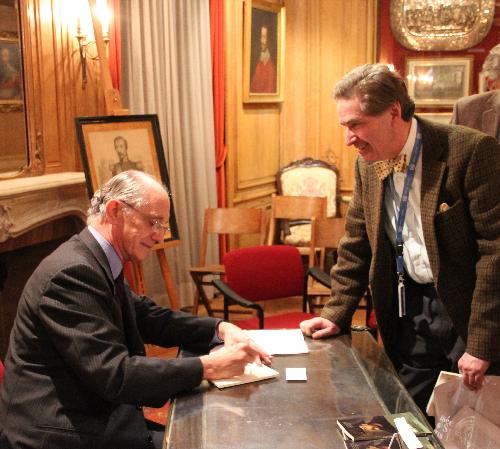
Wednesday 20 February -- my oral statement on the human
right to peace,
delivered at the Council, was particularly well received by the
non-governmental organizations.
Saturday 16 February. Glorious powder
at the Valais station of Laucheralp in the legendary Lötschenthal.
More than six hours of practically non-stop skiing.
Homo ludens!
Saturday
9 February. Superlative skiing at
the French station of Monts Jura, barely 20 minutes away
from the house. And what a view of basin lemanique and
the Salève from
the black piste in Crozet!
On Thursday 7 February I spoke
at the UN open-ended consultation on the human right to peace, focusing
on the justiciability of the various components of the right to
peace and recalling that even economic, social and cultural rights
are now justiciable thanks to the ratification of the Optional
Protocol to ICESCR. Homo faber!
Wednesday 6 February. Panel at the
Palais des Nations on women's empowerment and zero tolerance for
FGM.
Tuesday 5 February. The Government of Uruguay deposited
the 10th instrument of ratification of the Optional Protocol to
the International Covenant on Economic Social and Cultural Rights,
which will duly enter into force on 5 May 2013. Finally the justiciability
of economic, social and culural rights is being recognized. We
fought for it when I was a UN staffer, and now it has become a
reality.
Sunday
3 February. Splendid skiing at
the French station Les Houches with a spectacular view of the Mont
Blanc. Wonderful black pistes Kandahar and red Fontaines and Mur
des Epines. Lots of skiiers doing telemark -- an elegant,
but difficult discipline!
25
January 2013 -- 17th annual Ex
Tempore evening.
We duly celebrated Robert Burns' 254th birthday, and anticipated
the centennial of the birth of Albert Camus (7 November 1913).
In spite of the icy roads, 65 persons showed up and 15 performed,
including Aline Dedeyan, whose sketch was very original and a
pure delight. Her pianist Peter Cattan and male co-performer
Sebastien Verney were worthy of West End. We borrowed the electronic
piano from the Chapelle des Crêts and the mood was upbeat,
with the audience joining in the singing and clapping. For more
pictures see www.extempore.ch
24
Janaury - IBOR General Assembly. Bruna Molina President, Kirk Boyd
Secretary, myself as Vice-President and Treasurer a.i.
19 December -- intelligent and intelligible production
of Arthur Honegger's Les
aventures du roi Pausole at
the Grand Theatre. Fine staging and light effects. The mise-en-scène
was done by Robert Sandoz, and the king's daughter, La Blanche
Aline, was beautifully sung and acted by Sophie Angebault.
16 December. Glorious skiing in
Belalp. Pure powder
10
December -- Human Rights Day. Successful panel and workshop co-organized
by Earth Focus and IBOR.
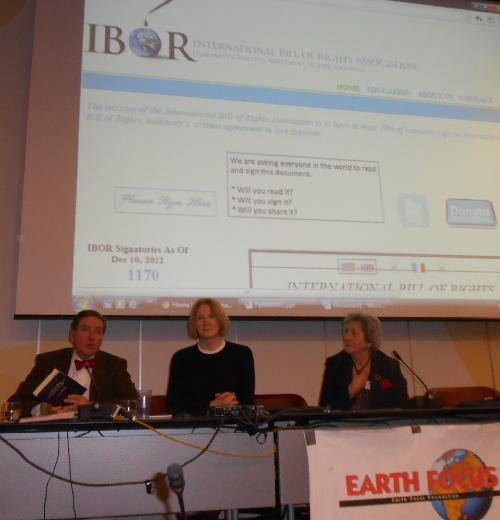
8 December the
XXIII issue of Ex
Tempore is out.
Shorter than Nr. 22, but very varied and rich.
7 December -- my article in the Netherlands
International Law Review on freedom of opinion and expression, written with my
doctoral student Aurea roldan, is now on-line.
2 November -- notwithstanding
hurricane Sandy that flooded the UN building on the East River--
the special rapporteurs still had the opportunity of presenting
their reports to the General Assembly. Here a picture on Friday
morning, just before the session of the Third Committee opened.
I actually enjoyed presenting my report,
and the States were kind enough with their comments. Here a picture
with the special rapporteur on the protection of human rights while
countering terrorism, Ben Emmerson.
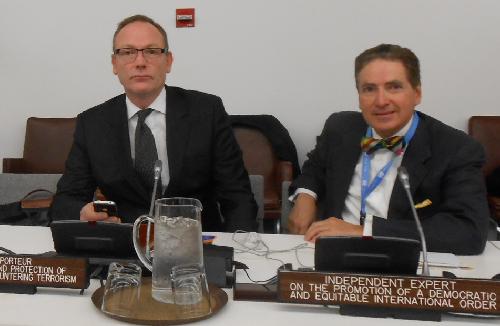
24 October, UN Day, the conseil du personnel
organized a manifestation outside the General Assembly hall, and
the United Nations Society of Writers had a stand with the last
issues of Ex Tempore. USG Jan Eliasson spent some time
at the stand and shared with me some thoughts by Dag Hammarsksjold,
which he repeated in his inspired statement at Victoria Hall
the same evening. Maestro Marek Janowski delighted us with a wonderful
rendition of Anton Bruckner's 4th Symphony.
The
October issue of En
Route,
the flight magazine of Air Canada, has an article on the Geneva
School of Diplomacy with a couple of photos of
myself at the Château de Penthes.
12 October -- wonderful performance of Swan
Lake at the Grand Theâtre by the Chinese National
Balllet Company. Wang Qinin was a particularly convincing Odette/Odile.
5 October
Rapporteurs Magdalena Sepúlveda
(extreme poverty),Cephas Lupina (debt) and I put out a
press
release on the Liikanen report and EU banking reform.
1-3 October
: UN Social Forum in room XX at the Palais des Nations. I spoke
on the panel on democratization on 1 October. Here my oral
statement. Good comments by the ngo community.
The October issue of the UN Special brings my article
on "Art
en campagne".
25 September -
spoke before activists of UNESCO Extea concerning my mandate and
how to enhance civil society participation..
21
September -- International Day of Peace. Issued my third press
release. The New York UN
media office also picked it up, and the UN
quotes (only the
first one).
16 September -- boat trip to Montreux/Château de
Chillon -- spectacular weather, good swim at the château.
15 September - "Art
en campagne" closing ceremony
in Collex-Bossy. Wrote article for the October issue of the UN
Special concerning this wonderful transfrontier exhibition and
comparing it with the exhibit in Belalp.
14 September -- lectured at Wesbster University,
meetings with the Asian Group and with the East-European Group.
13 September -- meeting with the African Group. Panel
on my mandate.
12 September -- in the morning meeting with the
Western and Other Group. In the afternoon presented my report to
the Human Rights Council. Here the statement,
and the press
release.
At the Council room XX with the Independent Expert
on International Solidarity Virginia Dandan
11 September -- lectured at GSD, meeting with the
Latin American and Caribbean Group. Gave interview on my mandate.
7
September -- took a swim in the Schwarzsee in Lötschental
-- cold and invigorating.
3 September -- "Boer
zoekt vrouw" op
BVN. Ich kijk praktisch nooit naar televisie. Maar ik vind dit
programma echt leuk.
1
September was a cold, rainy prematurely autumnal day, perfect to
sit at the fireplace and drink a Gamaret.
My report
to the Human Rights Council is
on the web. I'm scheduled to present it on 12 September.
OUR BERKELEY PROJECT FOR
AN INTERNATIONAL BILL OF HUMAN RIGHTS IS UP AND RUNNING
WE ARE ASKING ALL OF YOU TO GO ON THE SITE
http://www.internationalbillofrights.org/
READ OUR CONDENSED BILL OF RIGHTS, SIGN
IT AND SHARE
IT WITH FRIENDS.
ULTIMATELY WE ARE AIMING AT AN INTERNATIONAL COURT
OF HUMAN RIGHTS WITH JUDGMENTS THAT WILL BE ENFORCEABLE. PLEASE JOIN
US! On 16 July my first report to the Human Rights Council
went to the editors and translators. -- Wow, that's a relief!
On 10 July we held an informal
consultation with civil society at the Palais Wilson to brainstorm
on the scope and potential of my UN mandate. I derived good insights
that will be reflected on my report.
The Enlightenment philosopher, novelist,
polemicist, opera composer and citoyen
de Genève Jean
Jacques Rousseau was born on 28 June 1712 at Grand Rue 40 in the
center of the old town of Geneva.
The United Nations Society of Writers marked the 300th anniversary
of his birth with a celebration at the Escargot Bar of the Palais
des Nations, next to the Human Rights Council chamber -- with readings
from the Confessions and the Contrat Social. Was a JJR a precursor
of Henri Dunant and the International Committee of the Red Cross?
His ideas on the notion of the Westphalian state, the nature of
sovereignty, war, the condition of the soldier and prisoner of
war status certainly influenced -- for the better -- the development
of international humanitarian law.
Saturday 7 July was a perfect day for cycling --
thus, bikes on top of the car, drove to the Lac des Rousses in
France, next to the town of La Cure, cycled the 60 km around the
lake of Rousses and the Lac de Joux (Switzerland) and swam in both.
Glorious.
On
Wednesday 4 July I cooked and bottled 11 liters of jam. Our plum
trees have been generous this year. Now I am harvesting for the
slivovitz!
On Tuesday 3 July participated in the panel "Ending
Global Racism" in Room XXV, together with Jan Lönn, Secretary
of the ngo World Against Racism Network. Moderator was Professor
Krishna Ahooja-Patel of Women's International League for Peace
and Freedom.
On Monday 2
July lectured in Spanish to the masters students of the Universidad
de La Rioja at the Uni Dufour. Very alert students, clever questions,
good atmosphere.
The 2012 Geneva Book Fair on 25-29 Apirl was a great
success, this time dedicated to the 300th anniversary of the birth
of Jean Jacques Rousseau. Here a photo at the stand of P.E.N. International,
Centre Suisse romand, with J. Alexis Koutchoumow, Hoang Nguyen,
Claude Krul, myself and Maria Zaki.
My Guantanamo booklet
(lecture at the University of Trier, Institut für Rechtspolitik)
is now on the internet. Nr. 28, ISSN 1616-8828.
On Sunday 25 March, a glorious
spring day with fruit trees blossoming in our garden -- and all
around the countryside, we did our first barbeque of the season.
Life can be so wonderful - if kept simple and genuine. And yet,
nothing stops you from aiming at citius, altius,
fortius -- Κῦδος τοῖς Ὀλυμπίοις!
On Friday
23 March the President of the Human Rights
Council, Ambassador Laura Dupuy Lasserre, appointed me to the new
mandate of Independent
Expert on the Promotion of a democratic and equitable international
order, http://www.ohchr.org/EN/Issues/IntOrder/Pages/IEInternationalorderIndex.aspx.
The mandate has enormous potential and will
require much reflection. My desire is to be a bridge between North-South,
East-West, and to serve the cause of human rights by advancing
those immanent principles of human dignity and human equality that
make society work. We live in such a beautiful, rich planet that
there is no excuse for extreme poverty, structural violence, needless
conflict and war. Real - not just virtual - democracy can be achieved,
but we must believe in the rule of law, defend it and persevere.
Humanity needs more justice, mutual respect, patience, misericordia.
The mandate was
created by the Council on 29 September 2011. Si vis pacem,
cole justitiam. Nuevos
Derechos del Hombre just put up the
notice on their site. I lisened to one of my favourite pieces
-- Anton Bruckner's Te Deum laudamus.
On Wednesday 21 March I gave an interview to Russia
Today. It is high time to recognize the UN Charter as the
constitution of all of humanity and the ICJ as the world constitutional
court ! Let's have too an international court of human rights.
On Wednesday 14 March
Bruna Molina and I hosted a UN "side
event" on IBOR and
the International Court of Human Rights.
On Tuesday 13 March fruitful UN panel on women's
rights. Good audience -- and I even gave a TV interview afterwards.
On Saturday 10 March Ex Tempore co-sponsored a "happening" at
the Bains des Paquis with redings of poetry by Alphonse
de Lamartine, Hermann Hesse, Rainer Marie Rilke -- and Antony Hequet.
Diva
International reported on the event.
On Tuesday
6 March I was on a UN panel on indefinite detention and special
procedures. On Friday 2 March I was on another UN Panel on Camps
Ashraf and Liberty, together with Justice Geoffrey Roberts, Q.C.,
Professor Vera Gowlland, Gianfranco Fattorini, etc.
Post-carneval
abstinence is upon us, always an opportunity to take stock
and slow down a bit. Here a meditation on
Easter and a meditation on
the temple and us.
On 28 February
the Grand Theatre de Genève
gave a splendid performance of Bohuslav Martinu's Opera Juliette.
The producton by Richard Jones and costumes by Antony McDonald
were fascinating in a surrealistic way.
The February 2012 issue of the UN Special brings a short article
on Ex
Tempore.
On Tuesday 31 January the Grand Theatre de Genève
presented Jean-Jacques Rousseau's opera Le
Devin du Village, very
competently sung by Mark Milhofer and Norma Nahoun, also a
shorter opera or Intermezzo by Giovanni Battista Pergolesi, La
Serva Padrona. It's tremendous fun to discover these forgotten
gems.
On Friday evening 20 January 2012 we held the 16th
annual Ex
Tempore literary
salon, dedicated to the 300th anniversary of the birth of Jean-Jacques
Rousseau, but this time with only 47 participants, since the weather
was rather inclement. We still had a fine spectrum of English,
French, Spanish, German, Russian and even Vietnamese readings,
as well as Aline Dedeyan's very funny sketch.
On 11 January 2012 Professor Paul Gottfried, Horace
Raffensperger Professor of Humanities at Elizabethtown, Pennsylvania
and Guggenheim scholar posted a long article-review of "Völkermord
als Staatsgeheimnis" in the on-line site Takimag. Comments
follow galore. http://takimag.com/article/the_eternal_german_guilt_trip/print#disqus_thread
Carla and I had roast goose for Christmas. The
Gänseschmalz is wonderful for omelettes. Now we are
off again to the olive harvest in Piegon/Nyons, France. There is
something very genuine about climbing on an olive tree and plucking
olives one by one. The olive oil we obtain from the old-fashioned
mill is more flavourful than any other we have ever poured on decades
of salads. Which brings me to a new year's resolution: consume
more salads, more veggies and less animals.
On Sunday 18 December we sang Kodaly,
Rimsky-Korsakov and other favourites at the oecumenical concert
we give every December at St. Hippolyte/Chapelle des Crêts.
Since there were only three of us tenors this year, I could use
my lungs more generously. But the choir director mostly wants piano
or even pianissimo! Tja!
The December 2011 issue of UN Special brings my poem
Hiking
in Engadin -- even with photos!
On Thursday 8 December Earth Focus held its annual
human rights conference. Among participants were former UN High
Commissioner for Human Rights Bertrand Ramcharan, Nicola Furey,
Professor Bruna Molina and myself. Among other things, we introduced
our new website for the International Bill of Rights Association. http://www.internationalbillofrights.org/
On 15-18 November the 3 Swiss PEN Clubs commemorated
Writers-in-Prison day. A noted Libyan author
in exile -- Ibrahim Al Koni -- was our guest, and the evening was
intellectually challenging.
Professor
Israel Charny, Hebrew University, Jerusalem, just published a review
of my book "Völkermord
als Staatsgeheimnis" in
the Fall 2011 issue Nr. 8 of Genocide
Prevention Now.
On Friday 11 November I spoke at the
Club de la Presse on the Ashraf
crisis. Other panelists were Gianfranco
Fattorini, co-president of MRAP, Jacques Neirynck, member of the
Swiss Federal Parliament, Professor Christianne Perregaux, Jean-Charles
Rielle, member of the Federal Parliament, Eric Sottas, Secretary-General
of the OMCT, Queens Council Georffrey Robertson, Professor Eric
David and Préfet
Yves Bonnet. Let us hope that the crime of silence will be broken
and that the UN will take effective action to protect the 3400
innocent civilians in the camp. If R2P means anything, here is
a good place to apply it.
On Friday 4 November singing rehearsals for the oecumenical
Christmas concert began at the Chapelle des Crêts.
Once again the tenors are in the minority, which gives me the opportunity
to sing louder. Fun! Kodaly, Arrian, Berthier, Lécot.
On
Thursday 3 November the Association por la recherche, la promotion
et le Développement
de l'Ingénierie
Eco-Moderne (AIEM.DI) held ist constitutive assembly in Geneva.
Dominique Simondet is President, Geneva Conseiller Marc Falquet
was elected Director and I Vice-President in charge of international
relations.
On
Sunday 30 October Carla and I did the 3-hour hike through the Bois
des Chênes
near Vich (the "toblerone" walk),
through rustling forests in brown, red and yellow, next to the
murmur of the Severine stream.
The October issue of the UN
Special published my
short piece on the alpine horn, "Le cor des alpes, un instrument
de paix."
On Saturday 22 October Carla and I did a lovely hike
through the vineyards near Aubonne, collected over a hundred fresh
walnuts and chestnuts and I even took a final Indian-summer swim
in lake Geneva. It was wonderfully sunny and unseasonably warm--
both air and water temperature were around 14-15 degrees. The beach
was deliciously deserted.
On
Thursday 20 October the International Parliamentary Union held
a conference with Parlamentarians from all over
the world. I spoke on the links between civil and political rights
and the implementation of the right
to development.
On Monday
10 October, on the occasion of the commemoration of the World Day
Against the Death Penalty, I spoke at the Place des Nations at
a large gathering of the relatives of refugees at Camp Ashraf in
Irak, who have every reason to fear another massacre. I noted the
considerable increase in the number of death sentences and executions
in Iran, which pose a grave threat to all opposition leaders and
their families.
On Satuday 8 October Carla and I conducted the lay
service at the Chapelle de Crêts with readings from Matthew
and Mark. Such religious services are often more authentic
than official worship, and the tradition goes back to early
Christian times, when lay Christian communities met to meditate,
discuss, commune. It was beautiful and breathed life.
At the General Assembly of the United
Nations Society of Writers on Friday, 7 October, the board was
reelected and I was confirmed in my function as editor-in-chief
of Ex
Tempore.
Volume XXII is about to come out.
On Wednesday 5 October, after my morning lecture
and advising a master's student on her thesis, Carla and I "stole"
one last swim in the lake. Water temperature was 18 degrees, air
temperature 21. Not bad for beginning of October. But a cold front
is approaching. Alas. There we were, looking at the water and munching
on Noah's bagels from San Francisco. We are undecided whether the
pumpkin or the Asiago bagels are the best.
Just learned that my correspondence with Golo Mann
is in the Schweizerisches Literaturarchiv, http://ead.nb.admin.ch/html/mann_F.html.
Besides visiting him at home in Kilchberg, we had been together
on ZDF discussing the fallacious "collective guilt" doctrine, http://archiv.preussische-allgemeine.de/1988/1988_01_02_01.pdf
On
Tuesday 4 October I participated in the Second
International Conference "Public diplomacy and youth
volunteering" in Room VIII at the Palais des Nations,
organized by the International Youth Movement with headquarters
in Moscow. I spoke on the work of the International Bill of Rights
Association, made my introductory remarks in Russian and even
took some of the questions in Russian. Nice kids -- bright eyed,
bushy tailed.
It's UN panel time again. Monday 19
September on self-determination, Wedesday 21 and Thursday 22 September
on Camp Ashraf, Monday 26 September on Women's Rights, Tuesday
27 September noon on Kashmir, Tuesday 27 Sepember 3 p.m. on the
right to peace. Be glad when when UN Council is over.
On 11 September the Tagesspiegel in Berlin brought
a nice review of "Völkermord als Staatsgeheimnis" by Professor
Dr. Arnulf Baring (Berlin).
Carla and I cycled some 60 kilometers
around lac de Rousses (in France) and lac de Joux (in Switzerland)
on Sunday 25 September. It's Indian Summer and the air temperature
was 25 degrees, water temperature 17 degrees. We tried out both
lakes!
The human rights journal "Menschenrechte" just
published on page 29 of its Nr1/2011 a short but fine review of
my book "Völkermord als Staatsgeheimnis"
On Thursday 11 August I
was again on a UN panel, as a side-event
to the Advisory Committee of the Human Rights Council, this time with Professor Jean Ziegler,
member of the Advisory Committee, with Professor Guy Goodwin Gill
(Oxford), Professor Vera Gowlland (Geneva), Dr. Eric Sottas (Geneva),
the Spanish barrister Juan Garces (Madrid) and Mme
Maryam Radjavi.
I focused on the UNAMI report 2010 and its deplorable euphemisms.
On Wednesday
10 August I participated on the panel of the International
Conference on Camp Ashraf and the Responsibilities of the United
Nations, held at the Inter-Continental Hotel. Mme
Maryam Rajavi opened the conference, other speakers
were former Vermont Governor Howard Dean, former Congressman Patrick
Kennedy, former Amnesty International Chief Irene Khan, and the
French-Colombian human rights activist Ingrid Betancourt. I focused
on the issue of "legal
status" of
the residents of Ashraf and on the inacceptable notion of "legal
black holes". The Ashraf residents are human beings and enjoy
the protection of the International Covenant on Civil and Political
Rights, the Refugee Convention and the Fourth Geneva Convention
of 1949. As Baruch Spinoza observed in his Ethics, "nature
abhors a vacuum". The event was also reported in the German-language
press.
On Monday 8 August I spoke 7 minutes (I only had
the right to 4 minutes, but the chair did not cut me off!) at the
Advisory Committee of the Human Rights Council -- on the Declaración
de Santiago and possible amendments to the Draft Declaration on
the Human Right to Peace.
On Sunday 7 August I was one of the three
panelists in the expert consultation on the human right to peace,
held at the John Knox Centre. We are realy moving ahead!
On 28 July
at the General Assembly of the Société
Espagnole pour le Droit International des Droits Humains,
I was appointed Treasurer. Our President is Prof. Carlos Villan
Duran and our Secretary, Jose Luis Gomez del Prado, is currently
the President of the UN Working Group on Mercenaries.
On Thursday, 21 July the Human Rights Committee adopted
General Comment Nr. 34 on freedom of opinion and expression. Particularly
important is paragraph 49:
" Laws that penalise the expression of opinions about historical
facts are incompatible with the obligations that the Covenant
imposes on States parties in relation to the respect for freedom
of opinion and expression. The Covenant does not permit general
prohibition of expressions of an erroneous opinion or an incorrect
interpretation of past events. Restrictions on the right of freedom
of opinion should never be imposed and, with regard to freedom
of expression they should not go beyond what is permitted in paragraph
3 or required under article 20." For the full, advanced unedited
version see:
http://www2.ohchr.org/english/bodies/hrc/docs/GC34.pdf
On 21 July Europe News published
an article on the Cyprus question that relies in part on Professor
Andreas Auer's constitutional law paradigm of a Principled Basis
for a Just and Lasting Cyprus Settlement. http://europenews.dk/en/node/45462
See
also an earlier article by Henrik R. Clausen, which cites my work: http://europenews.dk/en/node/42657
On
Monday 4 July I spoke to a large group of Mujaheedins and their
families demonstrating at the Place des Nations on "Ashraf
et le crime du silence" just in front of the
United Nations building.
The International Human Rights Association of American
Minorities (IHRAAM) has invited me to join their Directorate. It
is a matter of ethics and intellectual honesty to serve the "unsung
victims".
The
June 2011 issue of UN Special carries my article "Music
as International Language."
On Friday 10 June I participated
on a UN panel, hosted by the Indian Council of South America and
the Indigenous Peoples and Nations Coalition on "Self-determination
and Human Rights". I spoke about the problem of international
law à la
carte, and the arbitrary application of the principle of self-determination,
depending on geopolitical considerations of the great powers, and
compared the situations in Kurdistan, Palestine, Katanga, Biafra,
Sri Lanka, Kosovo, Transnistria, Southern Ossetia, Abkhazia, Hawaii,
Alaska and Sudan.
On Tuesday
7 June I participated on a UN panel, hosted by OCAPROCE, on the
millennium development goals and in particular on goals 2 and 3
concerning education and equality of women at the workplace. I
spoke about the maquiladoras.
On Tuesday 31 May I participated
on a UN panel hosted by the International Human Rights Association
of American Minorities on "Detention
in Conflict." The
other panelists were Professor Dr. Joshua Catellino, Prof. Nazir
Shawl, Dr. Elvira Dominguez Redondo, Dr. Nadia Bernaz, and Barrister
Majid Tramboo.
On Monday 16 May
I delivered a paper at a closed UN
side event, a consultation on the human
right to peace, with the participation of the Western and
Eastern European groups of the Human Rights Council. Indeed,
dulce bellum inexpertis -- war is only attractive
to the unexperienced (attributed to Erasmus of Rotterdam)
Issue 934 of
the EU weekly newspaper published in Brussels New
Europe,
8 May 2011, carries my full-page analysis on the Armenian
Genocide and International Law on page 14.
On Saturday 7 May at the Stadttheater in Freiburg
in Breisgau, Germany, I delievered a Laudatio to
Judge Baltasar Garzon Real at a dignified ceremony during which
the Freiburger Kant Gesellschaft conferred upon him the Weltbürgerpreis.
The Badische
Zeitung published a nice report on 9 May at page 26. Zeit-Fragen published
excerpts of my Laudatio. Let's say with Kant: Sapere aude!
On
6 May my interview on "Völkermord
als Staatsgeheimnis"
was published in the Preussischen Allgemeine Zeitung, on page 10.
On 2 May I gave a lecture
in French on Rainer Maria Rilke at the Geneva Salon
du livre (bookfair). It was reasonably well
attended (some 25 people, PEN members and non-members). From
left to right Fanny Mouchet, Hoang Nguyen, Claude Krul, Alexis
Koutchoumow, Bruno Mercier, Zeki Ergas, myself. Literature is
so much nicer than politics!
On
Thursday, 28 April I read at the UN library the pretty thorough
review of my new book "Völkermord
als Staatsgeheimnis",
published in the Netherlands International Law Review.
The reviewer highlights the inter-disciplinary methodology of
the book. I guess that international lawyers will read the review
-- but how many historians?
http://journals.cambridge.org/action/displayFulltext?type=1&pdftype=1&fid=8266566&jid=NLR&volumeId=58&issueId=&aid=8266565
On
Wednesday 20 April I spoke on a panel held at the Club de la Presse
on the international criminal aspects of the Einsatzgruppen-like
actions of the Iraqui army against the Ashraf refugees. The Television
de la Suisse Romande reported on the panel in the Wednesday
evening news, and the Tribune de Genève and Le
Temps published
intelligent articles on the Ashraf crisis on Thursday 21 April.
On Saturday 16 April I participated on a panel on the Iraqui massacre
against the Aschraf refugees, Iranian Mujaheidins held at a camp
in Irak, formerly under the protection of the U.S. government.
On 8 April Iraqi soldiers attacked the refugee camp, killed 34
and wounded more than 300 refugees. Surely a crime against humanity,
a grave breach of the 4th Geneva Convention of 1949 -- disgraceful
and yet largely unreported. The other panelists were Pofessor Jean
Ziegler, vice-President of the Advisory Committee of the Human
Rights Council, Dr Jean-Charles Rielle, Conseiller national and
Député au
Parlement Suisse,
Pastor Daniel Neeser and
Marc Falquet, Député au Grand Conseil Genevois.
Here again we recognize the phenomenon of victims of crime -- and
victims of silence. More generally we are confronted with the
inhumanity of silence and indifference -- because these victims
are not deemed politically correct. We adopted
a declaration.
of On 31 March Canadians
for Genocide Education conferred upon me their "Educator's
Award" 2011.
CGE is an association of some 53 organizations of survivors of
genocide and ethnic cleansing including indigenous Americans, Armenians,
Bosnians, Chaldeo-Assyrians, Croatians, Cypriots, Germans, Greeks,
Jews, Kosovars, Kurds, Macedonians, Rwandans, Roma, Sinti, Serbs,
Slovenes, Tamils, Ukranians etc. I could not fly to the University
of Toronto to accept the award, but my acceptance
speech was
read out. It was reported in the press, including the German-Canadian Neue
Welt on
6 April, page 3. Genocide
Prevention Now, a publication edited
by Professor Israel Charny, Jerusalem, reported on it.
My new book "Völkermord als Staatsgeheimnis" has
just been published by Olzog Verlag, München, 2011. 206 pages,
Index, Facsimiles, ISBN 978-3-7892-8329-1
From the preface by Professor Dr. Karl Doehring, former Director
of the Max Planck Institut für ausländisches öffentliches
Recht und Völkerrecht
(Heidelberg): "... Aber letztlich geht es ihm um die Frage, ob es eine Kollektivschuld
der Deutschen für die Judenmorde gab. Das würde voraussetzen, dass
zumindest der 'normale' Staatsbürger von diesen Vorgängen etwas gewusst
habe, und zwar nicht nur durch Andeutungen und Flüsterinformationen, sondern
durch klare Kenntnisse. Dass eine solche Kenntnis nicht vorhanden war, belegt
der Autor in seinem Buch durch Heranziehung solider Informationen, auch aus den
Nürnberger Prozesssen, von Dokumenten und Aussagen von Zeitzeugen. Weitere
Versuche, eine Kollektivschuld der Deutschen zu belegen, werden and er Arbeit
des Autors nicht vorbeikommen..."
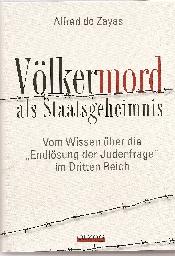
The UN Human Rights Council was in session in
March and the non governmental organizations put up some
of the most interesting panels. At the side-event on freedom of
the internet I participated from the audience and raised the issue
of censorship by Google in countries like France, Germany and Switzerland.
I participated myself on eleven panels on a variety of issues
-- the human right to peace, women and childrren in armed conflict,
self-determination, a restatement
of the law of human rights, and
the World Court of Human Rights. Some of the speakers were genuinely
inspiring and the public responded with intelligent
contributions and questions. A fruitful exercise and -- after all
-- better bla bla than boom boom.
On 1 March the FAZ published
on page 18 a shortened version of my letter to the editors concerning
the CDU proposal of establishing a National Day of Remembrance
for the Victims of the Expulsion 1945-48.
18-20 February I was in Nicosia, Cyprus for the
World Congress of Displaced Hellenes, which dealt with the expulsions
and massacres of Greeks of Pontus and Smyrna, Armenians, Chaldeo-Assyrians,
and with the "ethnic
cleansing" that
accompanied the 1974 Turkish invasion of Cyprus. The successful
colloquium was hosted by the Kyrenia refugees association “Adouloti
Kerynia”. I focused on the report of the International Panel "A
Principled Basis for a Just and Lasting Cypriot Settlement" and
on the need to start the process for a Constitutional Convention
in Cyprus. I gave several interviews, including to the Cyprus
Weekly.
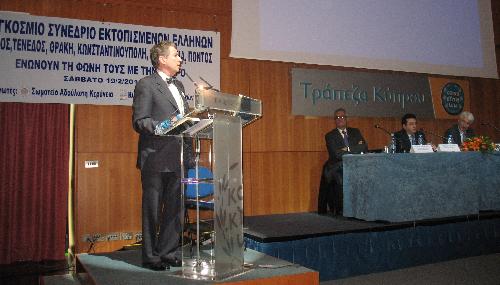
Friday evening 21 January: 15th annual Ex Tempore
salon. 63 UN and PEN Club members recited poetry in English, French,
Spanish, Dutch, Latin, and Vietnamese. Alas, this time we had no
Arabic, Chinese or Russian, although I managed to put in a couple
of Russian words edgewise. Aline Dedeyan did a fine sketch with
Alexis Koutchoumow. Connie Ouko sang her own songs in Swahili,
and a quartet sang 3 Bulgarian songs a capella. We had two pauses
in which people enjoyed Ngozi's shrimp with spinach, while other
guests brought home-made enchiladas, brownies, and all that wonderful
high-calorie finger-food. Practically nothing was left-over. The
last guests left at 0:30 Saturday morning. See "Le Numéro
XXI d'Ex Tempore est tiré; il faut le lire" U.N.Special,
février 2011, p.
10.
On
Wednesday 19 January I spoke at the Advisory Committee of the Human
Rights Council and commented on the progress report of the working
group on the Human Right to Peace. I actually went over my time
limit -- and, mercifully, the Chairperson did not cut me off. It
was very well received by the members and we had to make additional
copies of my oral statement.
Every now and again there comes a political and
moral essay that is worth reflecting upon. In that category we
should include Ambassador Stéphane
Hessel's October 2010 manifesto "Indignez-vous!". Every
young person -- and some older ones, particularly politicians !
-- ought to study it. Below is a photo taken at Mikhail Gorbachev's
World Political Forum Human Rights Conference in
Bosco Marengo, Italy, on 7 November 2008 together with Ambassador
Hessel, a collaborator at the drafting of the Universal Declaration
of Human Rights of 1948.
On 10 December, on the occasion of UN celebrations
of Human Rights Day, Curtis Roosevelt, grandson of Eleanor and
Franklin spoke to the students at the Geneva School of Diplomacy.
In the morning I also participated on a panel organized by Earth
Focus, in which I introduced Berkeley
University's Project 2048.
40
centimeters of snow in the garden -- haven't seen that for years!
Time to make snowmen, throw snowballs and go skiing.
This year P.E.N. International celebrates the 50th
anniversary of the founding of the Writers in Prison Committee,
upon a felicitous proposal of the Centre Suisse romand. On 15-18
November the three Swiss Centres commemorated the event
with public lectures by and discussions with notable speakers.
On 18 November our guest was Deo Namujimbo, a Congolese journalist
for Reporters
sans frontiers, the agence de presse Syfia Grands
Lacs and
InfoSud Suisse. For more than twenty years
he reported independently about political developments in the Congo,
covering in particular the war in East Congo, in Kivu and Bukavu.
After his brother, also a journalist, was murdered and Deo and
his family were repeatedly threatened, he obtained political
asylum in France, where he currently lives and continues writing
about the plight of the Congolese people, always with a sense of
proportions and a commitment to the human dignity of all concerned.
During the discussion I addressed issues of impunity, reconciliation,
the International Criminal Court and the role of the UN Mission
in the Congo.
The 17-minute video on the 100th
session celebration of the UN Human Rights Committee
on 29 October 2010 has now been issued, with excellent excerpts
of statements by Bertie Ramcharan, Robert Badinter, Mohammed Bedjaoui,
Antonio Cançado Trindade, Committee members and representatives
from UNHCR, ILO, etc.. http://vimeo.com/16823400.
I briefly speak on the implementation gap and the need to enact
enabling legislation so as to give Committee decisions status in
the domestic legal order of States parties and thereby facilitate
their enforcement.
On Sunday 7 November our Pontifex Benedict XVI
consecrated the Basilica of la Sagrada
Familia in
Barcelona before King Juan Carlos, Queen Sofia and 6,500 faithful
in the truly huge church. Some 51,000 faithful followed the ceremony
on giant screens outside Antoni Gaudi's (1852-1926) amazing building
(UNESCO world heritage site). Yet another reason to go back to
beautiful Barcelona. Last time I was there in 2004 for a P.E.N.
congress on writers in prison, I would not have dreamt that the
Basilica would be ready for Papal consecretion in my lifetime.
The building, the altar, the columns, the stained glass windows
are just spectacularly beautiful. Next year the Pope travels again
to Spain, this time to Madrid, on the occasion of the 26th
World Youth Day.
Friday 5 November was our second Christmas rehearsal
in the oecumenical choir of Crêts/St. Hippolyte. We added
to the program a piece by François Couperin that I had never
heard of before. Lots of fun for the tenors.
Friday 5 November was UPR day for the US at the
Human Rights Council. Most interesting was perhaps the one-and-a-half
hour presentation by Julian Assange, the founder of Wikileaks.
I posed three questions to him concerning Article 19 of the International
Covenant on Civil and Political Rights, the problems of national
security, censorship and self-censorship. What balance ought to
be struck with the crucial right in every democarcy to have
access to all information, the right to disseminate such information,
the right to ask questions and demand answers. This brought us
to the obligation to investigate violations of human rights
and international humanitarian law, and the issue
of impunity and universal jurisdiction. Indeed, if the ICC, ICTY
and ICTR were all established to fight impunity, what does this
mean with regard to the impunity of NATO coalition forces and Iraqi
police? There were tough questions asked and the large conference
room XXII was filled to capacity.
On
Thursday 4 November Mr. Ramsey Clark, 66th Attorney General of
the United States, spoke at the Pavillon
Gallatin of the Geneva School of Diplomacy. I
asked the first long question concerning the US mid-term elections
of 2 November and the dangers posed by the growing military-industrial
complex in the United States and the unconscionably high "defence"
budget, which eats up more than 50% of the U.S. budget, notwithstanding
urgent needs for health, education and general welfare. Ramsey
dedicated one of his books for me, "The Fire this Time",
which I read and used when I was professor in Chicago.
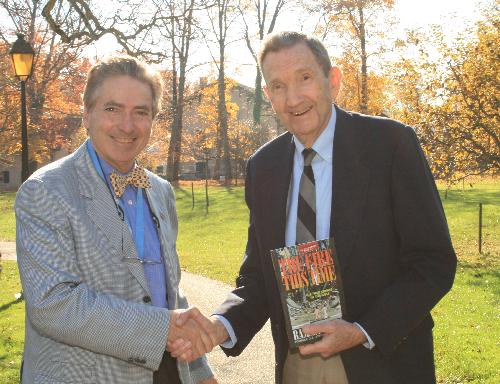
On Wednesday
3 Noverber, in connection with the preparation for the examination
of the U.S. report by the Human Rights Council, I participated
on the panel hosted by the International Association of Democratic
Lawyers, the Associaition of Humanitarian Lawyers, the Arab Lawyers
Union, and the International Youth and Student Movement for the
United Nations, devoted to the extra-territorial violations of
human rights by the United States and private military companies,
primarily in Iraq and Afghanistan. My paper focused on the right
of victims to a remedy. Other panelists were
former US Attorney General Ramsey Clark, Dr. Dirk Andriansens
of the Brussels Tribunal Executive Committee, and Prof. Curtis
Doebbler.
On Tuesday 2 November I spoke at the UN "side
event" on Self-Determination hosted by Ambassador Ronald Barnes.
Other panelists were Mrs. Mary Ann Mills, Tribal Chair and Tribal
Judge of the Kenaitze Tribe in Alaska, Mr. Kai'opua Fife, Mr. Pola
Laenui and HE Leon Kaulahau Siu of the Koani Foundtion of the Hawaiian
Kingdom. I focused on the implications of the Apology Resolutions
sigend by Bill Clinton in 1993 and by Barak Obama in 2009.
On Friday,
29 October the Human
Rights Committee commemorated its
100th session. I spoke on behalf of the International Society for
Human Rights at the 100th
session celebration of the Human Rights Committee. I focused
on human dignity as the source of all human rights and on the necessity
of enabling legislation in all States parties to the ICCPR so that
Committee decisions have status in the domestic legal order.
On Monday 20 September I delivered an
oral statement at the Human Rights Council on behalf of the International
Society for Human Rights.
On Thursday 16 September it was back to the UN for
the International P.E.N. panel with P.E.N. President John Ralston
Saul. Our P.E.N. Suisse romand organized a cheese fondue dinner
in honour of John Saul.
China is considering ratification of the International Covenant
on Civil and Political Rights. I
participated on panels at an ICCPR symposium in Beijing on Saturday-Sunday
5/6 December. At left on the photo is Harvard and NYU Professor
Jerome A. Cohen, who is also a bow-tie wearer like myself. I took
advantage of the opportunity to visit the Great Wall and the
Temple of Peace.
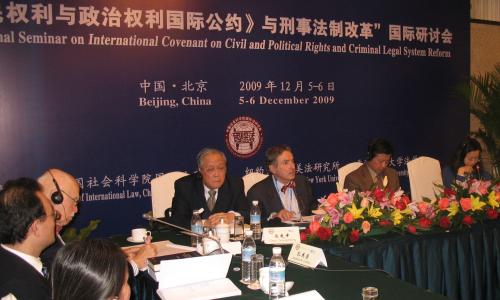
On Wednesday,
18 November, at the invitation of Professor Robert Kolb of the
Law Faculty of the University of Geneva I delivered a two-hour
lecture to an audience of 250 students on "The
Human Right to Peace", focusing on the Luarca Declaration
and on Human Rights Council Resolution 11/4 of 17 June 2009, by
virtue of which the Office of the UN High Commissioner for Human
Rights is preparing a study on the content and enforceability of
the right to peace. I elaborated on the existing norms
and the implications of the doctrine of "responsibility to protect" in
the light of UN Charter article 2(4). The students had lots of
good questions. It was quite refreshing -- and fun.
On 3-4 September I participated in the international
conference on the Armenian genocide, held at Beirut, Lebanon. I
gave several televised interviews. Below is the link to a published
article in El Mundo, the Spanish daily. http://www.elmundo.es/elmundo/2009/09/04/orienteproximo/1252078237.html
Also took advantage of the opportunity to visit old Phoenian cities
like Sidon and Tyre and admire the UNO world heritage sites.
The handbook is finally out -- Justice Jakob
Th. Möller
and I are happy to announce:
United
Nations Human Rights Committee Case-Law 1977-2008 --A
Handbook. 630-pages with annexes, index,
etc. obtainable from N.P.Engel, Kehl and Strasbourg,
2009, hardcover · ISBN 978-3-88357-144-7 · 2009 · € 148;
US$ 188; £120; SFr. 236 email: n.p.engel@eugrz.info
Extravantly expensive, but also frightfully thorough and still user-friendly.
On 16 July Jakob and I personally handed the
book to Navi Pillay, UN High Commissioner for Human Rights, at
her Palais Wilson office, and discussed its potential as a practitioner's
handbook. On 15 July the book launch at the Château de Penthes
took place, Christine Chanet spoke for the Committee and Bertie
Ramcharan about the commitment of OHCHR to the treaty bodies and
in particular to the creation of meaningful jurisprudence. After
the "official" part of the event, Isabel Möller presented Jakob
and me with "unofficial" Human Rights Committee baseball caps and
a bagfull of publicity flyers for the book. Here are the happy
authors
On 22 July I lectured at Sirnach in the canton of
St. Gallen, on the jurisprudence of the HRC and focused
on the spectacular "Views"
in Sayadi v. Belgium, and on the decision to take the Sayadi family
out of the terrorist list of the Security Council's Sanctions Committe.
Quite a success for human rights. The audience of some 200 kept
asking questions for more than an hour!
The UN Special of June 2009 brings a nice review by
the former High Commissioner for Human Rights Bertrand Ramcharan
on pages 18-19.
7-8 July 2009 I lectured on United
Nations Mechanisms to uphold international humanitarian law --
at the International
Institute of Humanitarian Law in San Remo, Italy, as part
of their very successful summer course. Bottom line of my lecture
is that human rights law is fully applicable during war and that
it is not replaced by the regime of international humanitarian
law. In other words, the International Covenant on Civil and Political
Rights is not suspended when armed conflict occurs and the Hague
and Geneva Conventions become applicable. The two regimes are complementary,
not mutually exclusive. The Latin maxim "lex
specialis derogat lex generalis" does not mean that
the laws of war replace the laws of peace -- this is a bad translation
of the Latin verb derogo,
which does not mean abolish (aboleo, exstinguo, tollo, rescindo)
but rather to make or propose modifications to a law. I thus suggested
a new maxim: Lex specialis suppleat lex generalis, i.e.
special legislation supplements or completes general legislation.
I also listened to the presentations by the other distinguished
lecturers, including ICJ Judge Abdul G. Koroma of Sierra
Leone, and took advantage to jump in the Mediterranean and swim
at the felicitous Morgana beach.
David Forsythe's Encyclopedia of Human Rights (Oxford)
just came out, including my six articles on
Jose Ayala Lasso (Vol. I, pp. 130-132), Aryeh Nyer (vol. 4, pp.
62-64), P.E.N. and Human Rights (vol. 4, pp.. 204-206), Bertrand
Ramcharan (vol. 4, pp. 313-314), Kenneth Roth (vol.4, pp. 204-206),
and Simon Wiesenthal (Vol. 5, pp. 327-330) ISBN13: 9780195334029.
The Oxford Encyclopedia of Public International
Law just uploaded my online article on "Guantanamo Naval Base".
On 9-10 December 2008 the Institut Pierre Werner
in Luxembourg, the Instituto Internazionale Jacques Maritain, Rome,
and the University of Luxembourg held a conference focusing on
new approaches to contemporary human rights issues. I spoke on "the universal system of Protection of Human Rights" and elaborated on a new human rights paradigm where enabling rights like the right to peace play a central role. Other
participants were Professorr Nicholas Michel of the University
of Geneva, Ambassador Christian Strohal of Austria and Roberto
Papini, Secretary General of the International Jacques Maritain
Institute.
The UN Staff magazine UN Special just published my article on the 60th anniversary of the Universal Declaration of Human Rights in its December issue, available online.
On 5 October 2008, at the Darwish Memorial Lecture hosted by PEN Suisse romand and the UN Society of Writers, Abdel Wahab Hani recited in Arabic the poetry of Mahmoud Darwish. I moderated the literary and human rights event, which was attended by 31 persons and lasted from 4 to 7 p.m. on a beautiful Sunday afternoon.. Claude Krul, Jacques Hermann and Zeki Ergas of PEN delivered profound words about the Palestinian poet, accompanied by readings of translations into French and English.
Mikhail Sergeyevich Gorbachev, President of the World
Political Forum,
hosted a fascinating conference at Bosco Marengo in Piemonte, Italy,
on the Implementation of the Universal Declaration of Human Rights
on 5-7 November. Top participants including the President of the
International Criminal Tribunal for the Former Yugoslavia, Fausto
Pocar, Anatoly Adamishin, UN Special Rapporteur Doudou Diène,
Danielle Mitterand, Professor Hal Gardner, Dr. Jona Bargur, Lelio
Bentes Correa, Ambassador Stéphane
Hessel, etc. etc. I spoke on the Human Right to Peace and personally
gave Gorbachev the book "La
Declaracion de Luarca" in his very hands -- chatted a
while with him and understood every word. He speaks a clear, friendly
Russian -- worthy of the glasnost predicate.
By the way, the second, revised edition of Carlos Villan Duran's
book just came out with Ediciones Madu in Spain. I considerably
expanded and updated my article "el crimen contra la paz".
Besides Spanish entries, there are other contributions in French
and English. At the conference I presented one working paper and
participated in two workshops. My closing remarks in the plenary
of the Bosco Marengo conference: "Alvaro Gil Robles has reminded
us of a number of uncomfortable realities. Allow me one observation:
our politicians always pretend to be the 'good guys', and yet they
often apply international law à la
carte, give lip service to human rights, keep silent about violations
by our friends and go around pointing fingers at the others. This
has resulted in a feeling of malaise and even pessimism, because
we know we are not being entirely honest with ourselves. The Oracle
at Delphi told visitors: know yourself - gnothi seaton (γνῶθι σεαυτόν) .
Maybe our politicians should try this for once -- just get some
mirrors. Then maybe when we regain our credibility we shall have
the needed strength to advance the cause of peace, disarmament,
solidarity and human dignity. Gospodin Gorbachev, eto sosedanie
bila diestvitelna prekrasna. Mi vse ochen blagodorim vas."
On 2-3 October the Office of the High Commissioner for Human Rights conducted a seminar on the links between articles 19 and 20 of the International Covenant on Civil and Political Rights. I was the first ngo to take the floor, and reported on the Charter of PEN International and our commitment to promote freedom of expression. I also summarized the relevant judgment of 7 November 2007 of the Spanish Constitutional Court. On 3 October I again took the floor with a statement on the responsibility of writers to promote international understanding. A few days after this important conference, on 10 October 2008, Professor Pierre Nora,
member of the Académie française, launched the Appel de Blois on behalf of the liberty of historians to conduct their research freely and the aberration of legislatures that pretend to legislate history and establish dogmas protected by penal law. I strongly support the Appel de Blois, which is consistent with article 19 of the International Covenant on Civil and Political Rights and with the First Amendment to the U.S. Constitution.
The Oxford Encyclopedia of Public International Law (edited by Professor Rüdiger Wolfrum, completely rewritten new edition of the famous Max Planck Encyclopedia of Public International Law, edited by Professor Rudolf Bernhardt) has just gone on-line. Of my five entries, three are up: "Forced Population Transfer", "Repatriation" and "Spanish Civil War". Two more are in the pipeline: "Marshall Plan" and "Guantanamo Naval Base". See http://www.mpepil.com/
On 18 September the Rheinischer Merkur brought a nice review of
my "50 Thesen zur Vertreibung". We have sold nearly 5000
copies in barely 4 months.
From 18 to 25 August Carla and I cycled blithely though Zuidholland and Zeeland, discovering historic mills and churches -- including the magnificent Grote Kerk in Maassluis with its wonderful Garrels organ. Maassluis lies on the Nieuwe Waterweg some 20 Km downstream from Rotterdam - and the fresh, raw haringe are
tasty indeed! The "Lange Jan" of the Nieuwe Kerk in Middelburg delighted us with its wonderful carillon.
On 26/27 July the Südmährischer
Landschaftsrat and the city of Geislingen an der Steige conferred
upon me their Kulturpreis. The Geislingen Zeitung and the Göppingen Zeitung reported on 28 July. I received the "Ehrenbrief"
from the hands of the Oberbürgermeister of Geislingen, Wolfgang
Amann, and from the Sprecher of the Süddmährer Franz Longin.
It was a beautiful ceremony in which I articulated my gratefuil
appreciation of the cultural heritage of this part of Europe that
produced Adalbert Stifter, Franz Schubert and Rainer Maria Rilke,
who mean so much to me. I also had the opportunity of introducing
the second, revised edition of my Rilke translations, published
in July 2008 by Red Hen Press in Los Angeles, with a preface by
Professor Ralph Freedman, the foremost Rilke and Hesse expert and
biographer in the United States. René Rilke was not "just"
a metaphysical poet, but at times a kind of Heimat
troubadour.. You can order Larenopfer from
the editor Mark E. Cull (mark@redhen.org),
also redhenpress8@verizon.net,
or go on the publisher's website www.redhen.org.
Of course, you can also find it through Amazon. The November 2005
issue of the Blätter
der Rilke Gesellschaft did a nice review of the
first edition of my translations of Larenopfer (Offerings
to the Lares -- i.e. to the household deities) with commentary.
In these charming 90 poems the then 20-year old Rilke sings his
hometown Prague and homeland Bohemia. For another review in a German-Canadian
journal click here.
The summer reading list of Millikin University in Decatur, Illinois,
praises Larenopfer and the "exquisite illustrations" by
Martin Andrysek. http://www.millikin.edu/english/archives/read07.html).
Red Hen Press is a small publisher specialized in poetry and literature
-- P.O. Box 3537 Granada Hills, California 91394, Tel. 818 - 831.0649,
Fax 818 - 831.6659.
On Friday 27 June I interviewed the Al-Jazeera journalist Samy El Haj, who spent six years unjustly detained in Guantanamo. The interview was published in the July issue of the Swiss newspaper Current Concerns.
On 7 May 2008 my 50 Thesen zur Vertreibung (info@verlag-inspiration.de)
were published in a first edition of 10,000 copies. ISBN 978-3-9812110-0-9.
www.verlag-inspiration.de.
DIE WELT commented them favourably in its edition of 10 May, page
2 http://www.welt.de/welt_print/article1982667/Sudetendeutsche_hoffen_auf_neuen_Prager_Fruehling.html
On 18-19 April I participated in an intenational conference on
the Armenian genocide, held at Nicosia, Cyprus, on the occasion
of the 93rd anniversary of the beginning of the genocide. I delivered
a lecture before
some 80 participants.
Bernward Koch-Boehm issued in March 2008 a CD-recording with
Erdenklang/da music, Nr. 61182. Deutsche Austrophon GmbH,
D-49356 Diepholdz, 2008. The piano CD is dedicated to Hermann
Hesse 1946 Nobel laureate for Literature, and reproduces
the text of Hesse's wonderful poem "Stufen",
together with my translation. The CD is entitled "Montagnola.
Dedicated to Hermann Hesse. Meditative Piano Improvisations".
Just lovely!
On 13 December 2007, I participated in the working meeting of
the advisory board of the Stiftung Zentrum gegen Vertreibungen
in Berlin. Our successful exhibit "Erzwungene Wege" is now
in Munich and will go on to Düsseldorf and Stuttgart in 2008.
A new exhibition on the German settlements in Eastern Europe is
now being elaborated by a team of experts.
On 10 December 2007, 59th anniversary of the adoption of the Universal
Declaration of Human Rights by the UN General Assembly, I was honoured
in Stuttgart with the Human Rights Award of the Danube Swabian Society
of Germany (Volksgruppe der Donauschwaben e.V.). My former law professor
in Tübingen, Professor Thomas Oppermann held the laudatio.
Nice to have such friends! The Tapach Choir accompanied the ceremony
with Schubert and Beethoven. The event was reported on 11 December
in the Stuttgarter Zeitung under the header "Donauschwaben
zeichnen aus", p. 22.
The University of Toronto journal Genocide
Studies and Prevention ( Vol. 2, No. 2, 2007) just published
my study "The Istanbul Pogrom of 6-7 September 1955 in the
Light of International Law". See abstract.The
article was translated into Greek and published in full length in
two consecutive issues of the Athens newspaper ó Politeis,
under the title "Septemvriana", September/October
2007. A longer version of the legal opinion was published in the
book by Professor Speros Vryonis, The Mechanism of Catastrophe,
ISBN 13: 978-0-9747660-6-5, second revised edition, New York 2007.
On 17 September I moderated a round table at the Palais des Nations,
Salle XXI, just outside the meeting room of the Human Rights Council.
Topic was "la dignité
de la personne au coeur des droits de l'homme", and the
participants were Archbishop Silvano Tomassi, Nonce apostolique,
Clément Imbert, représentant de Points-Coeur, Philippe
LeBanc, délégué permanent de l'Ordre Dominicain
aux Nations Unies, Jakob Möller, ancien juge à la Chambre
des Droits de l'Homme à Sarajevo, and Bertrand Ramcharan,
former UN High Commissioner for Human Rights.
In October 2007 the Institut für Zeitgeschichte in Munich,
together with the Zentrum gegen Vertreibungen in Berlin, published a small book "Die Posdamer Konferenz 60 Jahre danach",
containing the speeches delivered at the Berlin Colloquium on the
Potsdam Conference. The panelists were Prof. Helmut Altrichter of
the University Erlangen-Nürnberg, Prof. Alexei Filitov of the
Russian Academy of Sciences in Moscow, Prof. Anthony Nichols of
Oxford, Prof. Georges-Henri Soutou of the Sorbonne, and myself.
Prof. Guido Knopp, chief historian at ZDF, moderated the lively
discussion. On 23 July 2005 the Bayernkurier
had already published a short version of my thesis on Potsdam
Das unbewältigte
Erbe der Potsdamer Konferenz.
On 15 September 2007 I delivered a lecture at the Felix Ermacora
Institut in Vienna entitled "Rainer
Maria Rilke als Heimatdichter: von böhmischer Heimat zur
walliser Wahlheimat". There were about 100 persons in the audience
and I learned a lot from the discussion that followed.
On 18-19 June at the Hôtel Westminster in Nice, the UFR Institut
du Droit de la Paix et Développement de l'Université
de Nice Sophia-Antipolis, avec la collaboration de l'Institut International
de Droit Humanitaire (Sanremo), held a fascinating colloquium on
"Religions et Droit International Humanitaire". I was
on the panel devoted to "les doctrines religieuses et les sources
formelles du droit international humanitaire" and delivered
a paper entitled "Normes
morales et normes juridiques: concurrence ou conciliation",
which will be published shortly.
The Geneva Post Quarterly
just published my new article on "Minority rights in the New
Millennium". Citation: The Geneva Post Quarterly, Volume 2,
Number 1, May-June 2007, pp. 155-208
On 15-17 December I attended a conference on Cyprus
at Athens and took time to admire the Acropolis, grateful to the
ancient Greeks for their gift to civilization -- the cult of reason,
the Logos, and a sense for moderation, meden agan.
On 27 January we had a follow-up meeting in Geneva with Professor
Andreas Auer of the University of Geneva.
On October 17-19 New York University's Jean Monnet
Centre for International and Regional Economic Law and Justice
hosted an international symposium at its Florence (Italy) "La
Pietra" campus, which was devoted to "Rethinking
the Cyprus Problem: A European Approach". (http://www.nyulawglobal.org/events/cyprusparticipants.htm)
Professor Joseph Weiler presented a ground-breaking, thought-provoking
working paper, which a round
table of professors, diplomats, practitioners and experts analyzed.
We tackled not only the principles but also the functional and practical
aspects of Professor Weiler's proposals. I introduced and commented
the joint paper on constitution-making, which a year ago, on
12 October 2005, members of the "International Expert Panel
on a Cyprus Settlement" had presented before the European Parliament
in Brussels, where I had made opening
remarks on a "principled basis for a just and
lasting Cyprus settlement", and focused on the peaceful settlement
of disputes and on the principles of sovereignty, equality and independence
of States embodied in Article 6 of the European Union Treaty.
At the Florence round
table, I also delivered a paper on "The
Legal Status of the Turkish settlers".
See also Profressor
Auer's site.
On 8 October 2005 the International Association
for the Protection of Human Rights in Cyprus hosted a conference
under the auspices of the Secretary General of the Council of Europe,
and with the participation of numerous judges and advocates of the
European Court in Luxembourg and the European Court of Human Rights
in Strasbourg. Here is the abstract
of my paper. On
Thursday, 1 September 2005, at Nicosia, Cyprus, members of the international
expert panel presented "A
principled basis for a just and lasting Cyprus settlement in the
light of International and European Law" to President
Tassos Papadopoulos of Cyprus, to the leader of the Turkish-Cypriot
community, Mehmet Ali Talat, and to his eminence, Bishop Nikiforos
of Kikko. The paper was prepared by eight professors including Andreas
Auer, Marc Bossuyt, Peter Burns, Dieter Oberndorfer, Silvio-Marcus
Helmons, Malcolm Shaw and myself. Click here for the executive
summary. On 3 September 2005 I gave an interview to
the Cyprus Weekly,
which was published on 14 September 2005. I particularly enjoyed
meeting Titina Loizidou whose courage and perseverance
led to the now famous judgements of 1996 and 1998 of the European
Court of Human Rights. Titina is an expellee from Northern Cyprus
and her efforts to vindicate the right to return and the right to
restitution are of immeasurable value for the development of international
law. She is a true heroine of human rights and a living icon of
international law.
En 18-19 diciembre 2006 estuve de nuevo en Alcalá
de Henares, cuna de Cervantes, donde participé en la comision
de doctorado de un joven Aleman, Björn Arp, a quien le concedimos
la nota más alta de summa cum laude por una tesis
estupenda sobre los derechos de las minorías. A finales de
Noviembre había gozado de 5 espléndidos días
en Madrid, donde visité a mis primos de Oviedo, y conocí
el Club Zayas.
Disfruté enormemente el intercambio con 26 estudiantes de
derecho que tomaron mi curso intensivo en la Universidad de Alcalá,
ciudad patrimonio de la humanidad, llena de simpáticas cigueñas
y vestigios de la vieja ciudad Romana que se llamó en su
época Complutum.
The Frankfurter Allgemeine Zeitung
favourably reviewed the new edition of my book "Die deutschen
Vertriebenen" on 31 July under the felicitous headline "Fast
ein Klassiker" (almost a classic). This new
edition of Anmerkungen zur Vertreibung was published by
Leopold Stocker Verlag, Graz
(Ares), under the new title "Die deutschen Vertriebenen".
ISBN 3- 902475-15-3. For more information contact: carina.spielberger@stocker-verlag.com.
The new American version of the book "A Terrible Revenge"
(Palgrave/Macmillan) was mentioned favourably in the New York Review
of Books in an article by Robert Paxton on 22 November 2007 pp.
49-50 at p. 50. Didactically
useful are the Thesen
zur Vertreibung (ISBN 3-00-016129-6, August 2006).
The very successful Kohlhammer
paperback edition is now completely sold out. Myths and simplifications
are dangerous. One of those myths that I challenge in my theses
is the manichaean myth of the "good guys" and the "bad
guys", which ignores the complexities of life and disregards
the principle of equality and the imperative of respect for the
human dignity of each and every individual, including the victims
of the Vertreibung. At a commencement exercise at Yale
University in 1962 President John Fitzgerald Kennedy said something
very much in point:"The great enemy of truth is very often
not the lie-deliberate, contrived and dishonest-but the myth-persistent,
persuasive and unrealistic. . . . We enjoy the comfort of opinion
without the discomfort of thought.".
The English version of "The German Expellees" (Macmillan,
New York and London, 1993), was subsequently issued in paperback
under the title "A Terrible Revenge" (St. Martin's
Press, New York, 1994).In May 2006 a much revised third edition
was published by Palgrave/Macmillan. Both the English and the German
new editions contain about 20% new material, new photos, new statistical
tables, including new testimonies from Heinz Schön, a survivor
of the greatest sea catastrophe in history, the sinking of the "Wilhelm
Gustloff" on 30 January 1945 with more than 9,000 drowned refugees,
from young Ansgar Graw, born in the Federal Republic of Germany
of East Prussian parents, Bruno Kosak, an Upper Silesian who remained
in the homeland, Erika Murwig, a Pomeranian expellee who expresses
her sense of loss in poetry "Ein Traum", etc. High school
and college teachers may find the "Theses on the Expulsion"
didactically useful. Click here for the Theses.
On Friday 3 February 2006, the Frankfurter Allgemeine
Zeitung published my review
of Professor Norman Finkelstein's thought-provoking
book Beyond Chutzpah, University of California Press, Berkeley.
This book calls for an intellectually honest discourse on the Israeli-Palestinian
conflict and deplores the instrumentalization of Jewish suffering
for political purposes, in particular the aggressive use of the
past to excuse and justify human rights violations in the Israeli-occupied
Palestine territories today. Finkelstein is the son of Holocaust
survivors and keenly aware of the suffering of the Jewish people.
He convincingly calls for a human-rights approach to the solution
of the conflict. Click
here for the review in English translation.
On
Saturday, 6 August 2005 six thousand German expellees and their
families came to Berlin to commemorate "Tag der Heimat"
(The Day of the Homeland). Principal speakers were Angela Merkel,
head of the Christian Democratic Union, then candidate to the German
chancellorship, and now first woman Kanzlerin (Prime Minister) of
Germany, Otto Schilly, the then Social Democratic Minister or the
Interior,
Erika Steinbach, member of the German Parliament
for the CDU party and President of the Zentrum
gegen Vertreibungen in Berlin, and the first UN-High
Commissioner for Human Rights, Dr.
Jose Ayala Lasso, former Foreign Minister of Ecuador.
For the English text of Ayala's fine speech, click
here.
The Ullstein paperback
edition of Die Anglo-Amerikaner und die Vertreibung der Deutschen
(German version of "Nemesis
at Potsdam") is now sold out. On 6 September 2005
a much revised and enlarged 14th edition (hardbound) was published
by Herbig Verlag in Munich under the title Die
Nemesis von Potsdam,
ISBN 3-7766-2454-X. See the very positive review by
Patrick Sutter in the Neue
Zurcher Zeitung, also the review by Herbert
Ammon, and my interview "Verbrechen
gegen die Menschheit" The English version, originally
published by Routledge in London and Boston, ran three editions,
was then republished by the University of Nebraska Press, which
sold out two editions, and today hails its sixth revised and enlarged
edition with Picton Press, rockland, Maine. See "Publications",
infra.
Ninety-one
years ago the first genocide of the Twentieth Century started when
Ottoman Turkey attempted to exterminate its Armenian minorities
numbering two million. On 24 April 1915 the Armenian intelligentsia
was arrested and murdered in Istanbul and elsewhere throughout Turkey,
then the common folk in the towns and villages of Eastern Anatolia
were overrun, slaughtered, deported to the Syrian desert. One and
a half million human beings lost their lives. The survivors either
fled to Russia or went into exile, building the Armenian diaspora
of France, Canada, the United States, Argentina, Australia, etc.
On 20-21 April 2005 a major international conference was held in
Yerevan, with the participation (www.armeniaforeignministry.com/conference/speakers.html)
of American, Canadian, Belgian, German, Israeli, Turkish and other
scholars. My legal
opinion on the Armenian genocide and the 1948 Genocide
Convention was distributed to the participants, as well as the text
of my oral prensentation on International
Law, Human Rights and Genocide. On Sunday 24 April
an estimated one million persons, including many foreign delegations,
among others representatives of the U.S. and French Embassies in
Armenia, lay flowers and wreaths at the Genocide Memorial in Yerevan.
This very moving ceremony was followed by a performance of Verdi's
Requiem and an oecumenical service officiated by His Holiness Karaken
II, Catholicos of all Armenians, at the St. Gregory the Illumitator
Cathedral in Yerevan.
The
spring 2005 issue of the International Review of the Red Cross
was published in May in a new format, and is devoted entirely to
the growing problem of detention (volume 87, number 857, 2005) .
I contributed the chapter on "Human
Rights and Indefinite Detention" -- a matter of relevance
not only in connection with the so-called "war on terror",
incommunicado detention and ill-treatment in Guantanamo and Abu
Ghraib, but also in connection with the internment of undocumented
migrants and asylum seekers. |